Table of Content

Spaceman by Pragmatic Play: Crash Game Review, Demo Mode, Cash Out Mechanics and a Real-Money Reality Check

Last updated: February 2026 | Tested by: our in-house crash-game testing desk | Game type: multiplayer crash game (not a pokie)

Spaceman is Pragmatic Play's entry into the crash game category. No reels, no paylines, no free spins. Just a rising multiplier, a cartoon astronaut and one decision that decides everything. Do you cash out, or do you wait?

This review does three things most Spaceman pages skip. First, it publishes verified technical specifications and corrects two errors that circulate widely across other review sites. Second, it explains the 50% auto cashout function with actual arithmetic instead of a one-line mention. Third, it places the game in its Australian context, using published research on simulated gambling, demo play, return-to-player messaging and cash-out behaviour. Because "how do I win" and "what is this game doing to my bankroll" are two different questions, and only one of them has a mathematically honest answer.


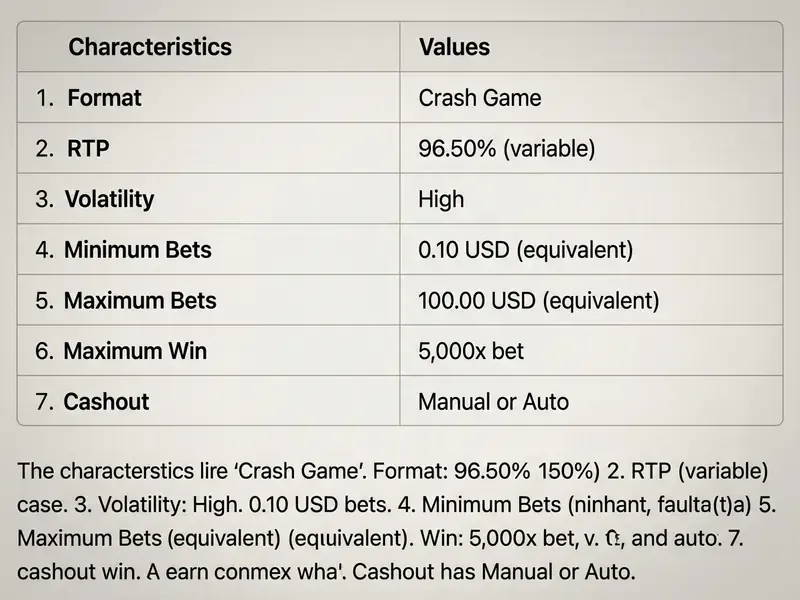
Provider

Pragmatic Play

RTP

96.50%

Volatility

High

Min bet

$1

Max bet

$100

Max win

$500,000 / €500,000

Spaceman by Pragmatic Play Crash Game

Quick summary: key facts before you play

  • Spaceman is a crash game, not a pokie. There are no reels, no paylines and no winning symbol combinations.
  • The verified RTP is 96.50%, equivalent to a 3.5% house edge. Some review sites list 95%. That figure is wrong.
  • Maximum multiplier: 5,000x. Maximum win: $500,000 / €500,000. Bets: $1 to $100 per round.
  • The signature feature is 50% auto cashout, which lets you bank half your stake at a low multiplier while the other half keeps climbing.
  • No cash out strategy changes the RTP. Exiting at 1.20x or at 50x produces the same long-run expectation of roughly minus 3.5% of turnover. Strategy changes variance, not edge.
  • Our 10-round, $5-per-round live test finished +$13.25. Small sample. Lucky sample. We explain below exactly why it proves nothing about your next session.
Quick summary key facts before you

Who this Spaceman review is for, and who should skip the game

This page is written for two readers. The first has seen Spaceman in a lobby, is curious about the crash format and wants the rules and the numbers before depositing. The second already plays Spaceman online and wants to know whether the 50% auto cashout is real value or clever packaging.

There is a third group, and honesty demands we name it. Skip this game if any of the following applies:

  • You dislike fast, repetitive play. Rounds resolve in seconds, and turnover accumulates quickly.
  • You tend to increase bets after a loss. Spaceman has a one-tap "double bet" shortcut sitting right there.
  • You are looking for feature variety: free spins, bonus rounds, a bonus buy. Spaceman has none of them.
  • You want a game where a system can shift the maths. It cannot. Not here, not anywhere with a fixed house edge.

If you are still reading, the rest of this review gives you the mechanics, the arithmetic and the limitations, in that order.

Who this Spaceman review is for

  1. Spaceman specifications at a glance

ParameterVerified value
DeveloperPragmatic Play
Release date28 March 2022
Game formatCrash game / real-time multiplayer (instant game)
RTP96.50% (not 95%)
House edge3.5%
VolatilityVariable, player-determined, no fixed setting
Maximum multiplier5,000x
Maximum win$500,000 / €500,000
Minimum bet$1.00
Maximum bet$100.00
ReelsNone. This is not a reel-based game
PaylinesNone
Free spins / bonus roundsNo
Bonus buyNo
Progressive jackpotNo
Key featuresManual cash out, auto cashout, 50% auto cashout, double bet, previous results, round statistics, live winners table, live chat
TechnologyHTML5, browser play, no download required
DevicesDesktop, mobile, tablet

Operators can configure some casino-side elements, and the published RTP should always be re-checked in the game information panel of the licensed casino you are using. Provider defaults and operator settings are not always identical.

Fact check: verifying RTP, volatility and mechanics

Several widely read Spaceman pages contain factual errors that materially mislead players. Worth correcting.

  • One operator page lists "RTP (Return to Player): 95%". That understates the return by a full 1.5 percentage points and overstates the house edge by roughly 43% in relative terms. The correct figure in Pragmatic Play's specification is 96.50%.
  • Two review sites list "Reels: 3" in the Spaceman specification table. Spaceman has zero reels. No grid, no rows, no symbols, no line evaluation. A specification table that lists reels for a crash game has been copied from a pokie template.
  • One reviewer describes the game as "void of any volatility setting". A more accurate framing: volatility in Spaceman is not fixed by the developer, it is generated by the player. Auto cashout at 1.20x every round is a low-variance game with frequent small wins. Holding out for 50x is an extremely high-variance game. Same RTP, radically different outcome distribution.

Bottom line: Spaceman is a pure crash format with a fixed 96.50% return and player-driven volatility. If a page tells you otherwise, whoever wrote it never loaded the game. Always sight the numbers yourself in the Pragmatic Play game card or in the rules of the casino Spaceman lobby you are playing in, because operator settings and currency limits do change.

Fact check verifying RTP, volatility and

2. What Spaceman is and how the crash game works

The core loop is brutally simple. Each round begins with a short betting window in the live lobby. You commit a stake. The astronaut launches, and a multiplier begins climbing from 1.00x upwards. At an unpredictable moment the run ends, the "crash", and every stake still in play is lost. Cash out before the crash and your stake is multiplied by whatever value was displayed at the instant you clicked.

That is the entire game. No second screen, no bonus trigger, no gamble feature, no accumulating meter. The decision architecture consists of one variable: when do you get out?

Multiplier growth and the moment the round ends

The multiplier is the whole product. It starts at 1.00x and rises continuously, slowly at first, then with visible acceleration and a soundtrack that climbs with it. Your payout equals stake multiplied by the value showing when your cash out registers, not the value you intended to take.

Crash mechanics differ from pokies in a structurally important way. In a reel-based game the outcome is fully determined the moment you press spin, and your only remaining input is watching. In a crash game, the crash point is set by the random number generator, but the payout you receive is a function of your own timing. That creates a powerful and slightly deceptive sense of agency. You are not choosing whether you win. You are choosing how much risk to accept against a distribution you cannot see.

Two clarifications worth making explicitly, because other reviews blur them:

  • The animation of the astronaut's flight path is presentation, not information. The graphical trajectory does not telegraph the eventual crash point in any way visible to the player. We could not locate published technical documentation from the provider describing the visual layer in these terms, so we flag this as our reading of the mechanic rather than a vendor-confirmed statement. The practical implication is unchanged. Do not try to read the animation.
  • Previous round results tell you nothing about the next round. Each round is generated independently. Ten crashes below 1.50x do not make a high multiplier "due". That is the gambler's fallacy, and crash game interfaces, which display recent history prominently, arguably invite it.
Multiplier growth and the moment the

How Spaceman differs from classic slot games

People search for the "spaceman slot" and the "spaceman slots" out of habit, so the confusion is understandable. Mechanically, though, the distance is large.

ElementSpaceman (crash game)Classic slot game
Outcome displayRising multiplier, single line of numbersReels, rows, symbol combinations
Player input after the betTiming of the cash outNone, the spin resolves itself
FeaturesAuto cashout, 50% auto cashout, live chatFree spins, bonus rounds, sometimes a bonus buy
VolatilityPlayer-determinedFixed by the provider, often published
Round lengthSeconds, continuous lobbySeconds, but individually initiated

Spaceman also layers on social information: a live chat, a table of recent winners with their cash out multipliers, and a statistics panel. Social feedback of that kind plausibly influences risk-taking. Watching another player bank 40x while you exited at 1.8x is designed to sting. We should be candid, though: experimental evidence specific to crash games and Australian players is not yet available in the published literature. The behavioural research cited below concerns social casino games, demo play and sports-betting cash out. Highly relevant by analogy, yes. But crash games as a distinct format remain under-studied.

Spaceman also layers on social information

3. How to play Spaceman: bets, launch and cash out

Placing bets and starting a round

  1. Load Spaceman from the crash game or instant games section of a licensed online casino. Availability, currency and limits vary between casinos, and some jurisdictions restrict the format entirely.
  2. Set your stake in the bet panel at the bottom of the screen. Bets run from $1 to $100. A "double bet" shortcut is available, which is convenient and, if you are chasing losses, dangerous.
  3. Confirm the bet during the countdown window. Miss the window and your bet queues for the following round.
  4. The round launches. The multiplier begins to rise. From here, only your exit matters.

A note on the "play now" buttons scattered across review sites: they take you to a lobby, not to better odds. The maths is identical wherever you play Spaceman online, so choose the operator on licensing, withdrawal rules and support quality instead.

Placing bets and starting a round

Manual cashout and setting auto cashout

Manual cash out is a single button. Press it while the astronaut is airborne and your stake settles at the displayed multiplier. Press it a fraction of a second too late and you receive nothing. On a fast connection this is a reaction-time exercise. On a poor connection it is a lottery, which is a genuine argument for auto cashout on mobile data.

Auto cashout works differently. You set a target multiplier in advance, say 1.75x, and the game exits at that value every round without input. Two practical benefits: it removes latency risk, and it removes in-the-moment emotional decisions, which are the single largest source of blown bankrolls in crash games.

Then there is 50% auto cashout, the feature that distinguishes Spaceman from most crash titles. It banks half your stake at one multiplier while the remaining half keeps riding. It can be set alongside a full auto cashout target, giving you a two-stage exit.

Because no competitor page actually does the arithmetic, we will.

Manual cashout and setting auto cashout

  1. The 50% auto cashout explained with numbers

The mechanic exists to answer a specific emotional problem. You want exposure to a 10x-plus run, but you cannot stomach losing the whole stake round after round while waiting for one.

Worked example. Stake $10. Set 50% auto cashout at 2.00x.

  • At 2.00x, half your stake ($5) settles automatically: $5 × 2.00 = $10 returned. Your original $10 is now fully recovered.
  • The remaining $5 stays in play. From this point the round is risk-free in nominal terms, because the worst outcome is breaking even.
  • If the astronaut crashes at 3.40x before you exit the remainder, you finish the round at $10. No loss, no gain.
  • Cash the remainder at 6.00x: $5 × 6.00 = $30. Round total: $40 from a $10 stake.
  • Cash the remainder at 20.00x: $5 × 20.00 = $100. Round total: $110.
4. The 50 auto cashout explained
Stake50% banked atRemainder exits atTotal returnNet result
$102.00x, $10Crash (lost)$10.00$0.00 (break even)
$102.00x, $103.00x, $15$25.00+$15.00
$102.00x, $106.00x, $30$40.00+$30.00
$101.50x, $7.50Crash (lost)$7.50minus $2.50
$101.50x, $7.5010.00x, $50$57.50+$47.50

Note the fourth row. Banking half at 1.50x does not cover your stake. You need a 2.00x exit on half the stake to reach break-even. That is the arithmetic that matters, and it is why "use the 50% cash out" as generic advice is close to meaningless without naming the multiplier.

The honest caveat. Hedging changes the shape of your results: more break-even rounds, fewer total wipeouts, occasional large upside. It does not change the expected value. Over a long enough sample, a careful hedger and a reckless holder both trend towards losing 3.5% of everything they stake. Hedging buys survivability and session length. Not profit.

Note the fourth row. Banking half

5. Key parameters: RTP, volatility, bets and maximum win

Disclaimer: This information is general in nature and is not a substitute for professional advice. Gambling involves financial risk. If you are having difficulty controlling your gambling, contact Gambling Help Online (gamblinghelponline.org.au) or the national gambling helpline on 1800 858 858.

RTP, volatility and risk in Spaceman

Spaceman's theoretical return to player is 96.50%. Expressed as an operator margin, the house keeps 3.5% of everything wagered over the long run.

What that means per round, in dollars:

Stake per roundExpected long-run loss per roundExpected loss over 200 rounds
$1$0.035$7.00
$5$0.175$35.00
$20$0.70$140.00
$100$3.50$700.00

Spaceman rounds resolve in seconds. Two hundred rounds is a plausible single sitting, not a month of play. Speed of play, not stake size alone, is what converts a small edge into a real financial outcome.

On volatility: calling Spaceman "high volatility" or "low volatility" without qualification is unsatisfying, because the game ships no fixed volatility rating and providers do not publish a variance figure for it. What we can say with confidence is that variance is determined by your cash out behaviour, and that any label applied to the game as a whole is a reviewer's shorthand rather than a vendor specification. Where you see confident volatility classifications elsewhere, the methodology behind them is not disclosed.

Spaceman rounds resolve in seconds. Two

Minimum and maximum bets, maximum win

Bets run from $1 to $100 per round. The maximum multiplier is 5,000x, and the maximum payout is capped at $500,000 / €500,000. The two constraints interact neatly: 5,000x on the maximum $100 stake equals exactly $500,000, so the cap binds precisely at the top of the range.

For perspective on frequency, multipliers in the thousands are extreme tail events. Our own testing across dozens of observed rounds peaked at 66x, and most observed crashes landed below 2.00x. Treat 5,000x as a marketing number, not a plan.

6. Our real-money test session: 10 rounds logged

To show what the game feels like rather than what a specification table implies, here is a fully logged sequence at a flat $5 stake per round, played in the live lobby with a mix of manual, automatic and 50% exits.

RoundOutcomeResult
1Crashed at 1.12xminus $5.00
2Cashed out at 2.10x+$5.50 (returned $10.50)
3Crashed at 1.05xminus $5.00
450% banked at 2.00x ($5.00), remainder exited at 4.50x ($11.25)+$11.25 (returned $16.25)
5Crashed at 1.01x, instant crashminus $5.00
6Cashed out at 1.80x+$4.00 (returned $9.00)
7Crashed at 1.30xminus $5.00
8Cashed out at 3.50x+$12.50 (returned $17.50)
9Crashed at 1.15xminus $5.00
10Cashed out at 2.00x+$5.00 (returned $10.00)
  • Session totals:staked $50.00, returned $63.25, net +$13.25, a 26.5% return on turnover.
  • What this session demonstrates:the rhythm of the game is a majority of losing rounds punctuated by a handful of modest wins, plus the occasional round where a hedged exit turns a coin flip into a solid result. Round 4 is the case for the 50% feature in miniature. Round 5, a crash at 1.01x before any human reaction is possible, is the case against manual play.
  • What this session does not demonstrate:anything about expected results. Ten rounds is statistically meaningless. A plus 26.5% return on a game with a minus 3.5% expectation is variance, nothing more. Published in isolation, a positive test log is precisely the kind of content that creates unrealistic expectations, which is why it sits next to the expected-loss table above rather than being framed as a result you should anticipate.
Quick Win heading-banner

7. Spaceman demo and free play: testing the game without real money

What you can check in Spaceman demo

The Spaceman demo runs on virtual credits with no deposit and no withdrawable winnings. Used deliberately, it is a legitimate learning tool.

  • Interface familiarisation. Where the cash out button sits, how the betting window behaves, what the statistics panel shows.
  • Testing auto cashout and 50% auto cashout. Configure both at once and watch the two-stage exit resolve in practice, without paying tuition fees for the lesson.
  • Feeling the round tempo. Rounds are short, and pace is a significant part of the risk profile. Better to discover that on virtual credits.
  • Watching the crash distribution. Observing across a hundred rounds how often runs terminate below 2.00x is a more effective corrective to optimism than any warning text.

Playing Spaceman free is also the cheapest way to answer a simple question: do you actually enjoy this loop? Some players find the single decision addictive. Others are bored by round twenty. Both answers are useful.

What you can check in Spaceman

How demo differs from real-money play

The game core is the same. The ledger is not. Two differences matter.

Technically, demo and real-money modes are separated at the balance and payment layer, not at the mechanic layer. Nothing about the crash generation is documented as differing between modes. Then again, nothing about the demo obliges you to make a decision with consequences.

Psychologically, the difference is risk salience. In demo mode a lost round costs nothing, so there is no loss aversion, no relief at a successful cash out, no impulse to recover. Every behaviour that causes harm in real-money play, chasing, stake escalation, extending a session past a planned stop, is functionally invisible in a demo. A demo therefore teaches you the interface and materially understates the emotional difficulty of the game. Skills acquired in demo mode transfer. Discipline acquired in demo mode does not.

This distinction is not academic. As the Australian evidence below shows, the link between free-play formats and later monetary gambling is one of the better-documented findings in the field.

How demo differs from real-money play

  1. Spaceman casino access and playing for real money

Spaceman real money play sits in the instant games or crash section of most lobbies that carry Pragmatic Play content. Access is not universal, though. Availability of casino Spaceman depends on your region, your operator's licence and the payment methods that operator supports.

Before you deposit anywhere, a short verification routine saves a lot of grief:

  • Check the licence and the operator's stated position on Australian players. If it is vague, treat that as a red flag.
  • Read the withdrawal rules: minimum payout, processing times, weekend delays and any per-week caps.
  • Confirm KYC requirements early. Uploading ID before your first withdrawal is easier than during one.
  • Confirm that Spaceman contributes to any bonus wagering you accept. Crash games are frequently excluded or weighted low.
  • Look for account-level limits: deposit limits, session reminders, self-exclusion. Their absence tells you something.

One more practical point on money. Crash rounds settle instantly, so your balance moves faster here than on a pokie with long feature animations. Set a session cap in dollars, not in "rounds", because rounds are cheap to lose count of.

8. Spaceman casino access and playing

Disclaimer: Playing for real money involves financial risk. The availability of Spaceman, bonus conditions and participation rules depend on your chosen platform and your region. Access conditions and legal restrictions differ by jurisdiction and by operator, and online gambling is prohibited or restricted in some places. Users are responsible for complying with local laws and age restrictions.

  1. Bonus buy, free spins and bonus rounds in Spaceman

Short answer: there are none. Spaceman has no bonus rounds, no free spins and no bonus buy. There is no scatter to land, no feature to purchase and no jackpot ladder. The multiplier and your exit are the whole feature set.

Why does that matter when you are comparing offers? Because a Spaceman bonus buy simply does not exist, so any page advertising one is either careless or deliberately misleading. Worth remembering when you weigh up the source.

It also changes how casino bonuses interact with the game. A few points to check in the terms:

  • Game weighting. Crash games often contribute 0% to 20% towards wagering, compared with 100% for many pokies.
  • Maximum bet while wagering. A $100 Spaceman round can breach a $5 max-bet rule and void the bonus.
  • Excluded game lists. Instant and crash titles appear on those lists more often than players expect.
  • Free spins offers. These are pokie promotions by definition. They cannot be used on a game with no spins.

So the honest framing is this: if a welcome offer is your reason for opening an account, check whether Spaceman even qualifies before you deposit. The bonus percentage in the headline means very little next to the wagering multiple, the expiry window and the maximum cashout attached to it.

9. Bonus buy, free spins and

10. Strategy for Spaceman: managing bets and expectations

No system beats a 3.5% house edge. What follows are risk-management frameworks, not winning methods.

ApproachCash out configurationRisk levelOutcome profileSuited to
ConservativeAuto cashout at 1.20x to 1.35xLowFrequent small wins; early crashes still wipe the roundPreserving a deposit, long low-intensity sessions
Hedged (50/50)50% banked at 2.00x, remainder manualMediumMany break-even rounds; keeps exposure to 20x-plus upsidePlayers wanting tail exposure without constant total losses
AggressiveManual exit at 10.00x or aboveHighLong losing streaks; rare large winsLarge bankrolls chasing extreme multipliers, highest ruin risk
Expected valueAny of the aboven/aminus 3.5% of turnover in every casen/a

Practical bankroll rules that genuinely reduce harm:

  • Fix a session loss limit in dollars before you load the game, and use the deposit limit tools the operator provides rather than relying on willpower mid-session.
  • Keep unit size at 1% to 2% of the session bankroll. At $100, that is $1 to $2 per round, not $10.
  • Set a time limit. Round speed is the multiplier most players ignore.
  • Never use the "double bet" shortcut after a loss. Progression staking on a negative-expectation game accelerates ruin without improving expectation.
  • Do not treat displayed round history as predictive. It is not, however tempting the pattern looks.
  • Aiming for smaller multipliers keeps you in the session longer, which cuts both ways: longer sessions mean more turnover, and more turnover means more expected loss.
Practical bankroll rules that genuinely reduce

  1. Theme, graphics, sound and social features

Visually, Spaceman is unashamedly retro-futurist: a purple and magenta sky, drifting planets, flying saucers, shooting stars. The central character is a caped, robotic spaceman with a quirky synth-pop voice and small comic gestures that give him real personality. He waits for his UFO before launch, then rockets upward as the soundtrack builds. When he crashes, the sky flushes red and he tumbles. It is a well-executed piece of audio-visual escalation. The music intensifies with the multiplier, which is elegant design and, functionally, an arousal mechanism.

The social layer is a genuine part of the product:

  • Live chat across the lobby during rounds.
  • Live winners table showing other players' stakes and cash out multipliers in real time.
  • Previous results strip and a statistics panel.
  • Double bet and duplicate-bet shortcuts.

This aesthetic, bright and cartoonish and arcade-adjacent, plausibly holds more appeal for younger adults and older adolescents than a card table or a fruit-symbol pokie. We flag that as an observation requiring empirical support rather than a demonstrated finding. No study we could locate has tested the age appeal of crash game art direction specifically. It still sits uncomfortably close to the research on simulated gambling and youth outlined below.

11. Theme, graphics, sound and social

  1. Mobile and cross-platform performance

Spaceman is built in HTML5 and runs in the browser on desktop, tablet and smartphone with no download required, on both iOS and Android. In practice, Spaceman mobile is the more common way to play, and the interface scales well. The cash out button occupies a smaller target area on a phone, which is one more reason to configure auto cashout rather than trusting a thumb.

One caution worth stating plainly. Mobile access increases convenience, and convenience reduces friction. Lower friction plausibly makes impulsive play easier at any time, in any place, including the ones where you had not planned to gamble at all. We could not locate a study measuring this effect for crash games specifically, so treat it as a reasonable inference rather than an established quantity. The practical response is simple either way: if you play on mobile, set your limits at account level, where a moment of impulse cannot override them.

12. Mobile and cross-platform performance. Spaceman

13. Australian evidence on simulated gambling, crash mechanics and gambling harm

A Spaceman review that stops at "RTP 96.5%, max win 5,000x" is a product listing. This section is what makes it a review.

Online gambling growth and the regulatory environment in Australia

Australian gambling participation has been shifting from venues to online formats, and that growth is now a central concern for regulators, alongside the broader expansion of iGaming products into mainstream digital entertainment.

Longitudinal data show overall participation edging down while harm rises. Reported participation sat at around 60.3%, compared with 61.3% a year earlier. And yet:

«The proportion of gamblers at risk of harm rose from 11.6% to 13.6%, meaning a greater number of people experiencing gambling harm.» Source: ANU National Gambling Study (2019 to 2024).

A shrinking player base with a growing at-risk proportion is the signature of formats that are faster, more accessible and more continuous. Crash games sit squarely in that category.

Simulated gambling, social casino games and migration to real money

Simulated gambling, meaning free social casino games, gambling mini-games inside other titles and demo modes, is widespread among young Australians. In a national dataset, over one third had played games with mini gambling components (37.4%) or free social casino games (36.9%).

«In a representative sample of 15,000 Australian adults, 13.4% reported participating in social casino games in the past year.» Source: Hing et al., synthesis of Australian and international data.

The migration question is the important one, and it has been studied directly:

«19.4% of participants reported that they had gambled for money as a direct result of playing social casino games.» Source: Gainsbury et al., online survey of 521 adult social casino players (2014 to 2016).

«Approximately one quarter of participants migrated from social casino games to online gambling within six months; the only unique predictor of migration was in-game micro-transactions.» Source: Gainsbury et al. (2014 to 2016).

In adolescents, the pathway shows up longitudinally:

«Young people who played games that simulated gambling at age 16 or 17 were significantly (40%) more likely to gamble with real money when they turned 18 or 19.» Source: 'Growing Up in Australia' longitudinal study, cited in the parliamentary inquiry into online gambling.

The relevance to Spaceman is direct. A free crash game demo is, definitionally, simulated gambling. It is a legitimate learning tool for an adult who has already decided to play, and simultaneously a documented on-ramp. Both things are true.

Free demos, practice games and free-play promotions

Demo modes on operator sites have been examined specifically in adolescent samples:

«Participation in free demo games on gambling websites was 14.3% in the Qualtrics sample and 22.9% in the Email/Advertisements sample.» Source: adolescent gambling study, open access via PubMed Central.

«Use of demo games on operator websites was associated with participation in most forms of monetary gambling across both adolescent samples.» Source: adolescent gambling study, PubMed Central.

Free-play promotions have also been tested on the commercial side:

«A 365-day field experiment using player-level data from four casinos examined whether free-play coupons encourage risk-seeking or risk-avoiding behaviour.» Source: Cho et al., field experiment (2023).

Free play is not neutral. It is a marketing instrument with measurable downstream effects on wagering behaviour.

Misunderstanding of RTP and the case for house-edge framing

This one directly affects how Spaceman's headline number should be presented. Australian experimental work compared different ways of communicating the same mathematical fact:

«The house-edge statement was understood correctly more often than any RTP format, and produced perceptions of lower chances of winning.» Source: experimental study, Australian sample of 603 participants (2022).

The house-edge format, phrased as "This game keeps 10% of all money bet on average", outperformed percentage-return framing on comprehension. Applied to Spaceman, the honest sentence is not "96.50% RTP". It is: "On average, this game keeps $3.50 of every $100 you bet." Same figure, radically clearer implication. A review quoting only the RTP is technically accurate and practically unhelpful.

Cash out features, in-play betting and behavioural biases

Spaceman's entire design is a cash out decision, so the sports-betting literature on cash out is the closest available analogue.

«Transaction-level data from a sportsbook show that cash-out decisions are quantifiable and can be modelled by operators through offer design.» Source: study of the disposition effect in cash-out betting, sportsbook transaction data.

The disposition effect, the tendency to lock in small gains too early while running losses too long, is well documented in that context. Crash games weaponise it in both directions: the low-multiplier exit that feels safe, and the held position that "must" pay out soon.

«Bettors on live events with micro-bets show higher rates of problem gambling; cash-out is used more frequently by those already gambling at harmful levels.» Source: 'A bad bet for sports fans', synthesis of evidence on in-play betting harm.

Cash out usage appears higher among bettors already gambling at harmful levels. That does not make cash out features inherently harmful. It does mean a feature marketed as "risk control" is disproportionately used by people whose risk is already elevated.

Young adults gambling online: the ACT case study

Jurisdictional research from the ACT has examined online gambling among young adults specifically, in a context where mobile access is near-universal and product marketing is heavily digital. The population most exposed to arcade-styled, mobile-first, socially networked gambling products is also the population with the least accumulated experience of losing. Spaceman's aesthetic sits in that space. We cannot cite a study measuring the appeal of this particular art direction to that cohort, but the combination of a $1 minimum, fast rounds and cartoon presentation is not obviously accidental.

14. Practical implications: demo use, real-money play and harm minimisation

Using the demo honestly

Recommend the demo for what it does: interface learning and feature testing. Do not sell it as strategy development, and do not present it as risk-free familiarisation with the experience of playing. The emotional core of the game, money at stake, is exactly what the demo removes.

Presenting real-money play, bonuses and casino access responsibly

Real money play is what the game exists for, and reviews pretending otherwise are dishonest. What responsible presentation requires is proportion: the house edge stated in plain dollars, the maximum win framed as an extreme tail event rather than an objective, and bonus offers described with their wagering conditions rather than their headline percentage.

Strategy discussions, expectations and harm minimisation

Every strategy section should carry the same closing statement. Cash out timing changes the distribution of your results, not their expectation. Put limits, session caps and self-exclusion tools alongside strategy rather than in a footer, because a reader arriving from a "Spaceman strategy" search is, by definition, the reader most likely to overestimate their control.

  1. Pros and cons

Pros
  • Genuinely different from pokies: one decision, immediate feedback, no filler animation
  • 96.50% RTP is at or slightly above the online pokie average
  • 50% auto cashout is a real mechanical differentiator, not a cosmetic one
  • Auto cashout removes latency risk and in-the-moment emotional decisions
  • Low $1 entry point, playable on any HTML5 device without download
  • Strong presentation, likeable character, effective audio escalation
  • Live chat, winners table and statistics add social texture
Cons
  • No bonus rounds, no free spins, no bonus buy, so the loop thins out over long sessions
  • 5,000x is achievable in theory and vanishingly rare in practice
  • Extremely fast rounds mean high turnover and high expected loss per hour
  • Social feedback and visible round history invite the gambler's fallacy
  • Design characteristics overlap with formats research links to elevated harm
  • Frequently excluded or weighted low in casino bonus terms
  • Widespread misinformation about the game's specs across review sites

Pros Cons

  1. Verdict

Spaceman is one of the better-designed crash games available, and Pragmatic Play deserves credit for the 50% auto cashout, which is genuinely intelligent mechanical design rather than a reskinned feature. The 96.50% return is competitive, the presentation is charming, and the short decision cycle is a legitimate change of pace from reel spinning.

It is also, structurally, one of the higher-intensity products in a mainstream casino lobby. Seconds-long rounds. A one-click loss. Live social comparison, visible history that means nothing, and a mobile build that is always within reach.

How do you hold both judgements at once? Like this: play the demo first, decide your session loss limit in dollars before you deposit, configure auto cashout rather than trusting your thumb, and remember that the game keeps $3.50 of every $100 you bet no matter how well you time the exit.

16. Verdict. Spaceman is one of

  1. FAQ about Spaceman: mobile, online access and game format

What kind of game is Spaceman?

Spaceman is a real-time multiplayer crash game from Pragmatic Play, released on 28 March 2022. It has no reels, no paylines, no symbols and no bonus rounds. A multiplier rises from 1.00x until a randomly determined crash point, and you must cash out before the crash to be paid.

What is the RTP of Spaceman, and is it really 95%?

The verified RTP is 96.50%, equivalent to a 3.5% house edge, so the game keeps about $3.50 of every $100 wagered over the long run. Some review pages incorrectly list 95%. Always confirm the figure in the game information panel at your licensed casino, since operator configurations can differ.

Does the Spaceman slot have 3 reels?

No. Spaceman has zero reels and zero paylines, despite being listed among "spaceman slots" on many sites. Specification tables listing reels for this game were copied from pokie templates and are wrong.

How does the 50% cash out work?

It settles half your stake automatically at a multiplier you nominate, leaving the other half in play. Banking half at 2.00x returns your full original stake, which makes the rest of the round a free roll on the second half. Banking below 2.00x does not fully cover the stake, so the arithmetic matters.

What is the maximum win in Spaceman?

The maximum multiplier is 5,000x and the payout cap is $500,000 / €500,000. That maximum is only reachable with a $100 stake at 5,000x, an extreme statistical outlier rather than a realistic target.

Can I predict when the Spaceman will crash?

No. Each round's crash point is generated independently by a random number generator. Previous results, the statistics panel and the animation of the flight path give you no predictive information at all.

Is there a Spaceman bonus buy or free spins feature?

No. Spaceman has no bonus buy, no free spins and no bonus rounds. Any page advertising a Spaceman bonus buy is describing a feature that does not exist in the game.

Can I play Spaceman free, and is the demo the same game?

Yes, a Spaceman demo on virtual credits is widely available and uses the same mechanic and interface. It pays no real winnings, and it does not replicate the pressure of wagering real money. Use it to learn the controls, not to build confidence.

Can I play Spaceman on mobile?

Yes. The game is built in HTML5 and runs in-browser on iOS, Android, tablet and desktop with no download. On mobile, auto cashout is strongly preferable to tapping manually.

What is the best strategy to win real money in Spaceman?

There is not one. Every approach, conservative 1.20x auto exits, 50/50 hedging or holding for 10x-plus, carries the same expected value of roughly minus 3.5% of turnover. Strategy changes the shape and volatility of your results, not whether they are profitable long term.

  1. Responsible gambling resources

Treat gambling as paid entertainment with an expected cost, never as an income source. Set deposit and session limits before you play, keep stakes proportionate to a bankroll you can afford to lose entirely, and never chase losses.

If gambling is causing you or someone you know harm:

  • Gambling Help Online, gamblinghelponline.org.au, free 24/7 chat and counselling
  • National Gambling Helpline, 1800 858 858, 24 hours
  • Self-exclusion, BetStop, Australia's National Self-Exclusion Register
  • Lifeline, 13 11 14

18+ only. Online gambling is prohibited or restricted in some jurisdictions, and you are responsible for verifying your local laws before participating.

18. Responsible gambling resources. Treat gambling

About this review: specifications were cross-checked against provider documentation and in-game information panels, and the session log above reflects an actual tested sequence at $5 per round. This review is informational, reflects the testers' assessment, is not financial advice and guarantees no outcome. Where evidence was unavailable, we said so rather than filling the gap.