Table of Content

Mines Game Online: How to Play the Demo and Real Money Version

Last reviewed and updated: April 2026 | Editorial review: iGaming Content & Compliance desk | 18+ only

Mines is an instant-win, grid-based gambling game. You reveal hidden safe cells on a board, watch a payout multiplier climb, then try to cash out before you click a mine. The idea comes straight from Minesweeper, the old desktop puzzle. Modern casino builds keep the grid but bolt on a fixed house edge, adjustable risk settings and a live cash-out button.

That last difference matters more than it sounds. Minesweeper rewarded logic. Mines game rewards nothing but timing, and the timing is priced against you.

«Before you look at any promotional headline or welcome bonus for Mines, check the underlying terms, the cash-out rules, and the house edge. A clear casino review and guide must start with what can be mathematically verified: game mechanics, return-to-player structures, and strict budget limits belong before any claim about potential winnings.» Claire Bennett, Senior iGaming Content & Compliance Editor

Provider

Stake Originals

RTP

99.00%

Volatility

High

Min bet

0.10

Max bet

100.00

Max win

10,000x

Mines Game Online How to Play

Quick Summary: Mines at a Glance

ParameterWhat you need to know
Game typeInstant-win, crash-adjacent grid game (RNG or Provably Fair)
Grid sizes3x3, 5x5, 7x7, 9x9 and up to 12x12 depending on the software provider
Mine countAdjustable, from 1 mine up to 24 (5x5 grid) or up to 80 (large Hacksaw grids)
Published RTP rangeApproximately 94.0% to 99.0%, depending on provider and grid configuration
VolatilityPlayer-controlled: low with 1–2 mines, extreme with 10 or more
Demo modeWidely available; identical game engine, virtual credits, no financial value
Mobile accessBrowser-based HTML5 play; PWA "Add to Home Screen" instead of unverified APK files
Guaranteed winning systemDoes not exist. The house edge is fixed and every round is independent

How this guide was put together. We read vendor documentation and operator help files for the four main Mines builds (Spribe, Turbo Games, Hacksaw Gaming, Stake Originals), compared published RTP figures against the numbers shown inside game info panels, and cross-checked every behavioural claim against peer-reviewed gambling research rather than affiliate copy. Where a figure could not be verified, we say so in the text instead of rounding it into a tidy number.

What Mines Is and How the Playing Field Works

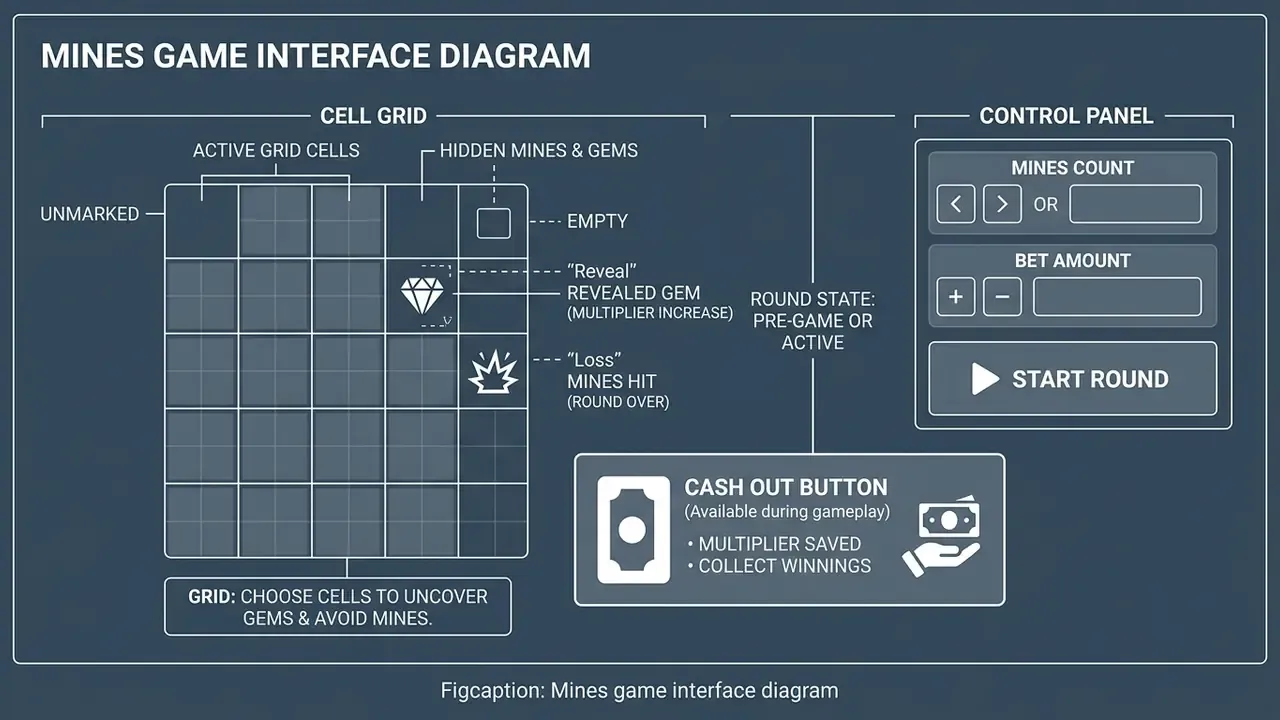
Mines game is a chance-based casino game built on a hidden grid, most commonly 5x5 with 25 total cells. You set a stake, choose how many hidden explosives are seeded across the board, then start opening cells. Every safe cell lifts the accumulated payout multiplier. One mine ends it: the whole stake for that round is gone instantly.

There is no partial loss, no consolation prize, no "nearly". That binary structure is the entire appeal, and the entire risk.

Visual layout of the Mines game: the 5x5 grid, revealed safe cells, hidden mines, the bet configuration panel and the live cash-out value

Grid sizes and mine limits by software provider

The size of the playing field is not universal. It depends entirely on the studio that built the title, which is why a generic 5x5 tutorial can look nothing like the lobby you actually opened:
  • Spribe Mines:standard 5x5 grid (25 cells), 1 to 20/24 mines, minimalist grid graphics, Provably Fair verification, published RTP of 97.0% and a stake range from 0.1 to 100 units (vendor documentation).
  • Turbo Games Mines:5x5 grid, 1 to 24 mines, 2D bomb-styled tiles, Provably Fair, published RTP 97.0%, stake range 0.1 to 100 units.
  • Hacksaw Gaming Mines:fully customisable grids from 3x3 up to 9x9, with anywhere between 1 and 80 active mines. Payouts scale with grid size, completed picks and active mine count.
  • Stake Originals Mines:5x5 grid with 1 to 24 mines, Auto Play with configurable stop conditions, fast round speed and instant cash-out. Some minefield setups extend to larger boards, up to 12x12 in certain configurations.
  • Galaxsys and Evoplay-style clones:usually 5x5 with capped mine counts and simplified auto-play tools.
Grid sizes and mine limits by

Payouts are recalculated from the ratio of remaining safe cells to remaining mines. So a 3x3 grid with 3 mines behaves nothing like a 9x9 grid with 3 mines. The small board is brutally volatile per click; the large board grows multipliers slowly across many picks, which feels safer and takes just as much off you over time.

Bet Size, Mine Count and the Win Multiplier

The multiplier in Mines rises after every safe cell revealed, calculated from the proportion of remaining hidden safe cells against hidden mines. Choose a higher starting mine count (anywhere from 1 up to 24 on a 25-cell grid) and the risk per click jumps sharply, while the payout coefficient scales aggressively with each survived selection.

The probability of selecting a safe cell on any given step is:

$$P(\text{Safe}) = \frac{N_{\text{total}} - N_{\text{mines}} - N_{\text{opened}}}{N_{\text{total}} - N_{\text{opened}}}$$

Where:

  • $N_{\text{total}}$ is the total cells on the grid (9 on a 3x3 board, 25 on a 5x5 board, 81 on a 9x9 board);
  • $N_{\text{mines}}$ is the number of hidden mines you selected before the round;
  • $N_{\text{opened}}$ is the number of safe cells already revealed in the current round.

Each safe reveal shrinks the pool of remaining hidden cells while the count of hidden mines stays fixed. So the bust probability climbs with every consecutive click. The operator applies a set mathematical multiplier at each step that already contains the house edge, which keeps the expected value of continuing below your original wager. Always.

Worked example (5x5, 3 mines): on the first click, $P(\text{Safe}) = (25-3-0)/(25-0) = 88%$. By the tenth click, $P(\text{Safe}) = (25-3-9)/(25-9) = 81.25%$, and the cumulative probability of surviving all ten picks in sequence drops to roughly 24%. The multiplier grows precisely because the survival probability shrinks. Nothing generous is happening.

Bet Size, Mine Count and the

When the Player Wins or Loses

A round of Mines ends in one of two ways. Either you press cash out and collect the accumulated win, or you click a mine and lose the stake in full. Unlike online slots with fixed reel spins, the length of play and the decision frequency sit entirely with you: lock in the profit, or keep opening cells.

Hit a mine at any stage and the game reveals all remaining mine positions, while every accumulated coefficient for that round resets to zero. Clear the whole board without triggering an explosive and the game processes an automatic cash out at the maximum achieved payout coefficient. That second outcome is rare at higher mine settings, which is exactly why it pays what it pays.

When the Player Wins or Loses

How to Play Mines Online: Step-by-Step Order of Actions

To play Mines online in a casino environment, you set a wager, choose the mine density on the grid, click hidden cells one at a time, and execute a cash out before an explosive tile appears. The interface follows the same sequence almost everywhere.

  1. Select bet amount: set your wager inside the operator's minimum and maximum stake limits.

  2. Configure mine count: choose how many mines (say 1, 3, 5, 8, 10 or 13) will be randomly hidden across the grid.

  3. Choose the grid size where it is supported. Hacksaw-style builds allow 3x3 through 9x9; Spribe and Turbo Games are fixed at 5x5.

  4. Start the round: confirm your parameters to lock in the bet and generate the hidden mine placements via a Random Number Generator (RNG) or a Provably Fair algorithm.

  5. Reveal safe cells: click unopened tiles one by one to uncover gems, diamonds or stars, multiplying the active stake.

  6. Cash out or continue: bank the accumulated profit with the cash out button, or risk it on another hidden tile.

Configuring Your Stake and Risk Level Before the Round

Before you launch a round, the wager size and the total mine count define the volatility profile and the financial risk of the session. A low setting (1 or 2 mines) gives you a high probability of safe reveals and slow multiplier growth. A high setting (10 or 15 mines) produces extreme variance where one misstep ends the round immediately.

Operators usually offer preset chips or slider bars so stakes adjust smoothly. Align the stake with a bankroll plan you wrote down beforehand, because high mine settings can burn through a balance in a couple of minutes flat.

Provider help files confirm the pre-round order of operations. In Stake's Mines help centre, the wager and the number of mines are set before pressing Play. Roobet's documentation allows the bet amount, minefield size and an Auto Cash Out trigger to be configured in advance. BC.GAME's Mines documentation adds an Auto Play mode that runs consecutive rounds on pre-set parameters, without manual confirmation of every click.

Configuring Your Stake and Risk Level

How to Cash Out During a Round

Cash out is executed by clicking the payout button, which multiplies your base bet by the current active coefficient and settles the round on the spot. Funds land on your real money or bonus balance immediately.

Every cash-out decision is the same trade-off. One more safe cell lifts the payout value; it also raises the statistical chance of hitting a mine on the next click. Once cash out is triggered, unrevealed tiles are shown and no further exposure remains for that round.

Two practical limits worth knowing: cash out is only available while the round is live, and only after at least one successful pick. Each click re-prices the live value of the bet, so the coefficient on the button is recalculated from the current grid state. Anything you have not banked stays fully exposed until your next decision. Not partially. Fully.

How to Cash Out During a

How to Verify a Provably Fair Mines Round

Provably Fair builds (Spribe, Turbo Games, Stake Originals and most crypto-casino clones) let you audit the outcome yourself instead of trusting the operator's word:

  1. Open the game menu and find the Fairness or Provably Fair tab before you bet.
  2. Copy the hashed server seed published prior to the round. This proves the mine layout was fixed before your first click.
  3. Note your client seed (you can usually replace it with your own string) and the nonce for the round.
  4. After the round closes, request the unhashed server seed, hash it with SHA-256, and confirm it matches the pre-round hash.
  5. Re-run the combination of server seed, client seed and nonce through the published verifier to reproduce the exact mine positions.

Where the online mines build uses a classic certified RNG rather than Provably Fair, look instead for independent laboratory certification of the generator and the payout tables. These are commonly issued by GLI (Gaming Laboratories International), eCOGRA or iTech Labs. Certification reports cover the RNG, the theoretical RTP and the published game rules as properties of the game itself, not as promises about your session.

How to Verify a Provably Fair

Mines Demo and Mines Free: Testing the Game Without Risk

Mines demo and Mines free play modes let you test the mechanics, interface responsiveness and multiplier scaling on virtual credits, with no deposit involved. As an entry point it is genuinely useful: you learn how grid selection and cash-out behave before any money is at stake.

Most operators launch the demo without an account. Some licensed platforms require registration first, and occasionally partial KYC, particularly where local rules restrict marketing gambling products to unverified visitors. If a site demands identity documents purely to open a free version, read the terms slowly before you go further. That is a signal, not a formality.

E-E-A-T fact check: demo mode versus real money conditions

Mines Demo and Mines Free Testing
ItemDetail
Statement"Playing Mines demo guarantees identical gameplay and winning patterns when switching to real money play."
VerdictFALSE.
EvidenceCertified studios run demo and real-money versions on the same game engine, so the RNG logic and theoretical RTP are not switched between modes; certification bodies such as GLI test the RNG, RTP and game rules as properties of the game. What demo mode cannot replicate is financial friction, psychological pressure, withdrawal conditions or loss aversion. Experimental work on practice modes shows free play can inflate confidence and lift bet sizing on transition to real money.
ActionAlways verify operator licensing and the published RTP inside the game help files before depositing real money.

«Participants who played simulated slots with inflated return-to-player settings subsequently placed significantly larger bets when they moved to real-money play.» Frahn et al., 2014, as reported in Hing et al., The convergence of simulated gambling, monetary gambling and harm, Australian Gambling Research Centre (2025)

What You Can Test in Mines Demo Mode

In demo mode you can measure how different mine counts affect multiplier accumulation, explore Auto Play and Auto Cashout, and rehearse your own bankroll rules without financial risk. Wins and losses display exactly as they would in the paid version, which gives you an honest visual picture of the volatility curve.

Checks worth running in the free version:

  • How quickly the multiplier scales at 1, 3, 8 and 13 mines on the same grid;
  • Whether the interface exposes a Provably Fair verifier and a bet history log;
  • Whether Auto Play supports stop-on-loss and stop-on-win thresholds;
  • How the grid renders and re-scales on your own phone screen;
  • How long a hypothetical bankroll of 100 base units survives at your chosen risk profile.

One observation from running these tests repeatedly: the multiplier curve at 13 mines looks thrilling on paper and lasts about four rounds in practice. Worth seeing on virtual credits rather than learning at $5 a click.

Research by Fiedler et al. (2024), a representative survey of 46,136 internet users, found that 54% of real-money online gamblers had also engaged in simulated gambling formats. Among those who did both, 33% showed elevated problem gambling indices, against 7% among real-money-only players.

What You Can Test in Mines

«Among participants who combined simulated and real-money betting, 33% displayed problem gambling indicators, against 7% among those who wagered money only.» Fiedler et al., Simulated Gambling: An Explorative Study Based on a Representative Survey (2024), N = 46,136

So Mines free play is useful for testing options and confirming grid behaviour, but treat it as an educational simulation, not a preview of financial outcomes. Demo credits carry no monetary value and cannot be withdrawn under any circumstances.

Mines Real Money: What to Consider Before Playing for Cash

Playing Mines real money brings four things into the picture that demo mode never touches: platform licensing, payment friction, wagering conditions and the house edge working against a live balance. Every bet moves actual funds.

Legal disclaimer and financial risk warning

Real money gambling carries inherent financial risk and can lead to monetary loss. Mines is a game of chance with a fixed negative mathematical expectation. No strategy or betting system can guarantee long-term profit.

Statutory and compliance requirements:

  • Age restrictions:you must be at least 18+ (or 21+ depending on jurisdiction) to participate.
  • Regional legality:online casino services are strictly restricted or regulated under local laws such as Australia's Interactive Gambling Act 2001. Confirm your position under the law in your own jurisdiction before depositing.
  • Responsible gambling:set deposit limits, loss limits and time caps before playing. If gambling stops feeling recreational, free support is available from Gambling Help Online (1800 858 858) and BetStop, the National Self-Exclusion Register in Australia.
Quick Win heading-banner

Deposits, Stakes and Available Game Options

To reach real money Mines you need to complete identity verification (KYC), fund the account through a supported payment channel, and open the paid version of the game inside a licensed casino catalogue. Deposit methods commonly include bank transfers, debit cards, e-wallets and cryptocurrency, depending on operator availability and local jurisdiction. For Australian users, the rails you meet most often are PayID and bank transfer, Visa and Mastercard debit, Neosurf prepaid vouchers, and crypto options such as BTC, ETH, LTC and USDT on offshore crypto-first platforms.

When you assess an online casino for real money play, check the operational detail rather than the front page:

  • Stake limits. Vendor documentation for Spribe and Turbo Games Mines lists a range from 0.1 to 100 units per round, but the actual floor and ceiling are set by each operator and each currency. Confirm them in the cashier and the paytable rather than assuming a universal figure.
  • Withdrawal terms. Processing times, identity checks and daily or monthly payout caps vary between brands. Check whether verification is requested before or after your first withdrawal request, because that single detail decides how fast your money moves.
  • Game options. Verify whether the provider (Spribe, Turbo Games, Hacksaw Gaming or Stake Originals) offers official Provably Fair tools inside the game menu, and whether a demo toggle stays available after you deposit.
  • Balance management rules. Read how the operator separates real, bonus and locked funds, and which balance a Mines round draws from first. Getting this wrong is how players accidentally wager a bonus they meant to keep aside.

In our editorial review work analysing operator transparency for iGaming audiences, documented in our iGaming market compliance analysis, we looked at how deposit limits and payout disclosure affect user retention and safety. Operators that publish withdrawal friction points, minimum deposit tiers and verification timelines upfront give players a materially safer environment for comparing real money options. The quiet ones tend to be quiet for a reason.

Deposits, Stakes and Available Game Options

Mines RTP and Why a High RTP Does Not Guarantee a Win

This information is general in nature and does not replace professional advice. Real money play involves financial risk. If gambling has stopped being entertainment, free support is available through Gambling Help Online on 1800 858 858.

Updated: the theoretical Return to Player for Mines is not a single figure. Published values across mainstream builds span roughly 94.0% to 99.0%, depending on the studio, the grid size and the configured mine count. An RTP percentage is a statistical long-term average across all global plays, and it says nothing about a short individual session. Formally, $\text{RTP} = \mathbb{E}[\text{payout}] / \text{stake}$, so a 96% game is programmed to retain 4% of total turnover across a very large number of rounds.

Mines RTP and Why a High
ProviderPublished RTPGrid rangeMines (min–max)Notable features
Spribe97.0%5x51–20/24Provably Fair, Auto Play, stake range 0.1–100
Turbo Games97.0%5x51–24Provably Fair, 2D bomb grid, stake range 0.1–100
Hacksaw Gaming~94.0% (as published by UK operator MrQ)3x3–9x91–80Fully custom grids, payouts scale with grid and mine count
Stake Originals~99.0% (as published by Stake.us)5x5, up to 12x12 minefield setups1–24Instant cash out, Auto Play with stop conditions, house edge around 1–2.5%
Other clones (Galaxsys, Evoplay-style)Verify in game infoUsually 5x5Provider-dependentFeature sets vary; confirm RTP in the help file

Treat the number inside the game's own information panel as authoritative for the version you have open. The same brand name can carry different RTP configurations across operators and jurisdictions, and the difference between 94% and 99% is not cosmetic.

Experimental evidence from gambling communication studies shows why the wording of these figures matters:

«Experiments conducted across online slot and multiplier game players demonstrate that standard percentage RTP messages (such as '90% average payout') are frequently misunderstood by players as a high probability of winning in a given session. Framing the cost in natural house-edge terms, such as 'this game is programmed to keep $4 for every $100 bet on average', significantly improves player understanding of expected long-term loss.» Newall et al., Experimental Research on Gambling Cost Communication (2023/2024)

«Participants shown a '90% average payout' message rated their chance of winning significantly higher than a no-information control group, with an odds ratio above 5.» Newall et al., Never tell me the odds (2024–2025), N = 6,062, UK and US Prolific samples

In a short session of Mines, variance dominates everything. You might string together six clean rounds, or hit a mine on the first click four times running. A 97% RTP simply means the mathematical cost of play is set at 3% across extended turnover. It offers no protection against rapid depletion during volatile high-mine rounds.

«79.9% of participants correctly interpreted the house-edge wording, a materially higher share than under the standard RTP message.» Newall et al., How best to improve upon return-to-player information in gambling (2023), N = 603, Australian sample

Mines Strategy: How to Manage Stakes and Risk

A Mines strategy cannot alter the house edge or manufacture long-term profit. What structured betting can do is manage session volatility, keep bet sizing consistent and give you a cash-out rule you follow instead of improvising. That is a real benefit, just not the one most strategy pages advertise.

Comparative analysis: Mines betting strategies

StrategyBase bet sizeMine countCash-out timingRisk levelMathematical reality and limitations
Low-riskFixed, 1–2% of balance1–3 mines1–2 safe cells (1.05x–1.20x)Low, steadyHigh win frequency; one mine hit erases several small profits
High-riskFixed, under 1% of balance5–10 mines4+ safe cells (3.00x–10.00x+)Very highExtreme variance; a long losing series drains the balance quickly
Martingale (progressive)Minimum table betConstant (1–3)Fixed target, e.g. 1.50x–2.00xExtremeStake grows as $2^n$; hits table caps or bankroll limits fast
Anti-Martingale / ParoliLow base, double on winConstant (1–5)After 2–3 consecutive winsHighProtects the bankroll during losing runs; profit depends on streak timing
D'Alembert+1 unit after a loss, −1 after a winConstant (1–3)Fixed low targetMediumSlower escalation than Martingale, but still a step-wise drawdown
1:1 ratioFixed minimum1 mineImmediately after 1 pickLowest availableHighest per-click safety (24/25 on a 5x5 grid) but tiny multipliers
10 Bets system1–5 units, table-drivenRotating 13 → 8 → 6 → 4Fixed multiplier per seriesMediumStructured record keeping; no edge over the RTP
Pattern playFixedAnyAfter a fixed number of picksDepends on picksNo mathematical advantage; reduces impulsive clicking

Low Risk: Fewer Mines and an Early Cash Out

The low-risk approach sets a small mine count, typically 1 to 3, and cashes out after 1 to 3 safe cells. Returns are modest, roughly 1.05x to 1.20x per round, and the per-step probability of success stays high.

It produces frequent small wins and a gentle session curve. It does not change the expectation. A single loss on a 1-mine grid can erase the profit built up over a dozen earlier rounds. Fewer mines and an early exit reduce dispersion, not the built-in cost of play, so low-risk strategies manage short-term swings while the long-term cost embedded in the RTP stays exactly where it was.

The 1:1 Ratio Strategy (Minimum Volatility Profile)

The 1:1 ratio sets the mine count to exactly one and opens exactly one cell per round before cashing out. On a 5x5 grid that gives a 24/25 chance, or 96%, of surviving the click, paired with the smallest multiplier the game offers. In practice it is the lowest-volatility way to run Mines: sessions stretch out, swings stay tiny, and the fixed house edge grinds the balance down slowly across sustained turnover. Some players pair it with continuous or auto play to keep the cycle mechanical and boring, which is arguably the point.

Pattern Play: Removing Emotion From Cell Selection

Mine placement is generated randomly before your first click, so no geometric sequence of picks carries any advantage. None. What pattern play offers is procedural discipline: picking along a fixed diagonal, cross, perimeter or corner-to-corner route stops you hunting for "hot" zones and keeps round pacing steady. Decide the pattern length in advance, say four picks on a diagonal, and cash out the second the pattern completes. The value is behavioural, not mathematical, and it is worth having anyway.

Auto Play With Stop-Loss and Take-Profit Triggers

Auto Play in Mines (Stake Originals, Roobet, BC.GAME and most Spribe integrations) runs a pre-set batch of rounds on fixed parameters. Configure it defensively:

  1. Number of rounds: cap the batch, for example 20 to 50 rounds, so the session has a natural end point.
  2. Stake per round: no more than 1–2% of your session bankroll.
  3. Auto Cash Out multiplier: set the exact coefficient at which the round closes automatically, such as 1.20x or 2.00x.
  4. Stop on loss: halt automatically once cumulative losses reach a set amount, for example 20% of the session bankroll.
  5. Stop on win: halt once cumulative profit hits a target. This is the setting that prevents "one more round" escalation, and it is the one players skip most often.
Auto Play With Stop-Loss and Take-Profit

Practical Test of the Paroli Strategy (20 Rounds, One Mine)

Unlike the classic Martingale, Paroli increases the stake only after a win and resets to the base bet after a loss, aiming at short controlled winning streaks. The progression below uses a $1 base bet, one mine on a 5x5 grid and a fixed 2.14x cash-out target, resetting to $1 after any loss and doubling after any win up to the third step.

Progression stepStakeIf the round winsIf the round loses
Step 1$1Move to step 2Return to step 1
Step 2$2Move to step 3Return to step 1
Step 3$4Return to step 1 and bank the streakReturn to step 1
RoundStake ($)MultiplierResultRound profit ($)Cumulative ($)
112.14xWin+1.14+1.14
22n/aLoss−2.00−0.86
31n/aLoss−1.00−1.86
412.14xWin+1.14−0.72
522.14xWin+2.28+1.56
64n/aLoss−4.00−2.44
71n/aLoss−1.00−3.44
81n/aLoss−1.00−4.44
912.14xWin+1.14−3.30
1022.14xWin+2.28−1.02
1142.14xWin+4.56+3.54
121n/aLoss−1.00+2.54
1312.14xWin+1.14+3.68
142n/aLoss−2.00+1.68
1512.14xWin+1.14+2.82
1622.14xWin+2.28+5.10
174n/aLoss−4.00+1.10
181n/aLoss−1.00+0.10
1912.14xWin+1.14+1.24
2022.14xWin+2.28+3.52

Reading the result correctly: this 20-round sample finished at +$3.52 on a total turnover of $34. A favourable sample, that is all. Look at rounds 6 and 17: a single loss at step 3 wipes out the entire streak profit. The structural weakness of Paroli in Mines is exactly that. Repeated failures at the third step make recovery harder each time, and the system depends on short winning streaks that are rare by design. Treat it as bet-sizing discipline, never as an income method.

The "10 Bets" System: Rotating Mine Counts With a Written Table

"10 Bets" is a low-bankroll structured system that rotates through four series of ten rounds, cutting the mine count each series and deriving the next series' stakes from the current one. You need a notebook or a spreadsheet, plus strict adherence to the target multipliers:
  • Series 1:10 rounds with 13 mines, cash out above 2.02x (1 pick);
  • Series 2:10 rounds with 8 mines, cash out above 2.13x (2 picks);
  • Series 3:10 rounds with 6 mines, cash out above 2.30x (3 picks);
  • Series 4:10 rounds with 4 mines, cash out above 2.05x (4 picks);
  • Then return to 13 mines and repeat the cycle.
The 10 Bets System Rotating Mine

How the table is filled. Start series 1 with ten $1 stakes. After each round, write the stake for the corresponding round of the next series: subtract one unit after a loss, add one unit after a win, never dropping below the $1 minimum. When the ten rounds are done, the row you have just written becomes the staking plan for the next mine setting.

Mines and targetR1R2R3R4R5R6R7R8R9R10
13 mines, 2.02x (1 pick)$1 loss$1 win$1 win$1 loss$1 win$1 win$1 win$1 loss$1 win$1 loss
8 mines, 2.13x (2 picks)$1 win$2 loss$2 win$1 loss$2 win$2 loss$2 loss$1 loss$2 loss$1 loss
6 mines, 2.30x (3 picks)$2 win$1 win$3 win$1 win$3 win$1 loss$1 loss$1 loss$1 loss$1 loss
4 mines, 2.05x (4 picks)$3 win$2 win$4 win$2 win$4 loss$1 loss$1 loss$1 win$1 win$1 loss
13 mines, next cycle$4$3$5$3$3$1$1$2$2$1

Players who use it generally stop after 10 to 12 completed rows. The system imposes structure and caps impulsive escalation, which is worth something. It cannot overcome the operator's mathematical edge, and over enough rounds that edge reasserts itself no matter how neatly the table is filled.

Martingale and Other Stake-Escalation Strategies

Progressive systems such as Martingale require doubling the wager after every lost round, chasing recovery of prior losses plus a profit equal to the base stake on the next successful cash out. Anti-Martingale flips it and doubles after a win to ride positive streaks. D'Alembert moves in single fixed units, up after losses and down after wins.

«Computer simulations of the Martingale system show that the average result across many sessions remains negative and converges on the built-in house advantage.» Dubach, statistical analysis of Martingale systems in fixed-odds games (2026)

As statistical analyses of progressive systems in fixed-odds games show (Dubach, 2026), doubling strategies run into three hard walls:

  1. Exponential stake escalation. Seven consecutive losses require a wager 128 times the base bet ($1 → $2 → $4 → $8 → $16 → $32 → $64 → $128). Ten losses in a row demand 1,024 base units.
  2. Table bet limits. Casinos enforce maximum bet caps on Mines, which cuts the doubling sequence off at a certain tier. Active bonus terms often cap it tighter still.
  3. Negative expected value. Each round's outcome is independent, so changing wager sizes cannot lift the mathematical RTP. Stake patterns redistribute when losses arrive, not whether they arrive.
As statistical analyses of progressive systems

«The empirical exponent of the multiplier distribution in crash games measured ≈1.98, matching the theoretical value of 2.0 under a fixed RTP.» Dubach, Gambling Fairness Paradox: Statistical Validation of Crash Game Outcomes (2026)

Why does that matter for Mines? Because it shows the multiplier ladders in this game family behave exactly as a fixed, disclosed house edge predicts. There is no hidden rhythm sitting there for a betting system to exploit.

General Discipline Rules That Apply to Every Mines Strategy

  • Set a session budget first, then choose a strategy that fits inside it. Never the reverse.
  • Match the strategy to your temperament. A system you abandon halfway through is worse than no system at all.
  • Decide three numbers before you start: total stake, target profit, maximum acceptable loss.
  • Control emotion. Chasing losses is the fastest route to an empty balance, and it always feels rational at the time.
  • Test in demo first so you learn the controls and the multiplier curve without paying tuition for it.
  • Read promotion terms before opting in, especially game weighting for instant games.
General Discipline Rules That Apply to

Where to Play Mines Casino Games: Choosing a Site and Accessing the Offer

Choosing a reliable casino for Mines comes down to four checks: official gaming licensing, independent software certification, readable bonus terms and local legal compliance. Adult Australian researchers comparing online casino platforms offering Mines get more from ten minutes in the terms and conditions than from any promotional headline.

[CHECKLIST: Verifying an online casino before playing Mines]
• [ ] Licence and legal status: a valid licence from a recognised regulator, with regulator-facing obligations published.
• [ ] Software authenticity and Provably Fair: the game is supplied by a certified provider with an auditable RNG or hash verifier.
• [ ] Bonus transparency: wagering multiplier, max bet caps and instant or crash-game restrictions are clearly stated.
• [ ] Withdrawal speed and conditions: no hidden fees, clear cash-out limits and documented KYC timelines.
• [ ] Mobile compatibility: the grid scales correctly in a mobile browser without freezing or clipped controls.
• [ ] Responsible gambling tools: deposit limits, cool-off periods, reality checks and self-exclusion are available.
• [ ] Support access: live chat or email with published response windows, tested before you deposit.
Where to Play Mines Casino Games

Comparing Platform Types for Australian Players

The Interactive Gambling Act 2001 restricts the provision of certain online casino services to Australian residents, so the practical landscape splits into platform archetypes rather than one tidy ranked list. Compare them on structure, not on bonus size:

Platform archetypeTypical Mines supplierPayments commonly seenKYC and verificationWithdrawal profileKey caution
Social / sweepstakes casinoStake Originals-style in-house buildsCard purchase of coin packagesIdentity check before prize redemptionRedemption windows, not classic cash-outsPrizes operate under promotional-sweepstake rules, not gambling licences
Crypto-first casinoSpribe, Turbo Games, in-house Provably Fair clonesBTC, ETH, LTC, USDTOften tiered: light at deposit, strict at large withdrawalsFast on-chain payouts, network fees applyOffshore licensing means limited local recourse
Licensed offshore fiat casinoHacksaw Gaming, Spribe, Turbo GamesPayID and bank transfer, Visa and Mastercard debit, NeosurfFull KYC before first withdrawal24 to 72 hours plus banking timeVerify whether the licence covers Australian residents
Regulated domestic wagering brandInstant-game catalogues where permittedPayID, debit card, BPAYMandatory verification at sign-upSame-day to 48 hoursCasino-style instant games may not be offered at all

No archetype is automatically safe. The deciding factor is official, dated documentation and regulator-facing obligations, never marketing claims, coin bundles or headline percentages.

Who Should Skip Mines Entirely

Worth saying plainly, because most guides do not. This game suits nobody who needs the money back. Skip it if:

  • You are chasing losses from another game or another session;
  • You cannot state your maximum acceptable loss before you open the lobby;
  • Fast round pacing tends to pull you into longer sessions than you planned, and Mines rounds can run under five seconds each;
  • You are working through wagering on a bonus where instant games contribute 5% or less, since the turnover maths rarely favours you;
  • You want a game with a skill component, because there is not one here beyond bet sizing and exit timing.

If two or more of those apply, a deposit limit or a cool-off period is a more useful next step than a bonus code.

Who Should Skip Mines Entirely. Worth

Bonuses, Deposits and Offer Terms for Mines

Welcome deposit matches and free spins routinely carry game weighting rules that limit, or completely exclude, instant-win titles like Mines from wagering contribution. Before you opt into an offer intending to play mines casino games with it, read the fine print properly.

Bonus terms to verify before depositing:

  • Game weighting. Instant and crash games may contribute only 5% to 10% toward turnover requirements, sometimes 0%, against 100% on standard slots.
  • Max bet limits. Bonus terms often cap the stake per round, for example $5.00, which rules out aggressive betting strategies during wagering.
  • Expiration caps and cash-out limits. Check whether bonus funds expire after 7 to 14 days, and whether promotional winnings face a maximum withdrawal ceiling.

Worked wagering example for instant games. Say you accept a $100 bonus with 30x wagering. On slots at 100% weighting you turn over $3,000. If Mines contributes 10%, every $1 wagered counts as $0.10, so the requirement becomes $30,000, ten times the work at the same stake level. At 5% weighting it is $60,000. Add a $5 max-bet cap and you are looking at 6,000 rounds at maximum stake. Run this calculation before opting in. Often enough, declining the bonus and playing with unrestricted cash is the cheaper option mathematically, which is not what the banner suggests.

Context for why promotional formats deserve caution: the Australian Gambling Research Centre reports in You win some, you lose more (2023) that 26% of Australians aged 12–17 had played social casino-style games in the previous 12 months, which shows how free and promotional products act as an on-ramp into monetary gambling.

Bonuses, Deposits and Offer Terms for

Mines Mobile and Mines Download: Browser or App?

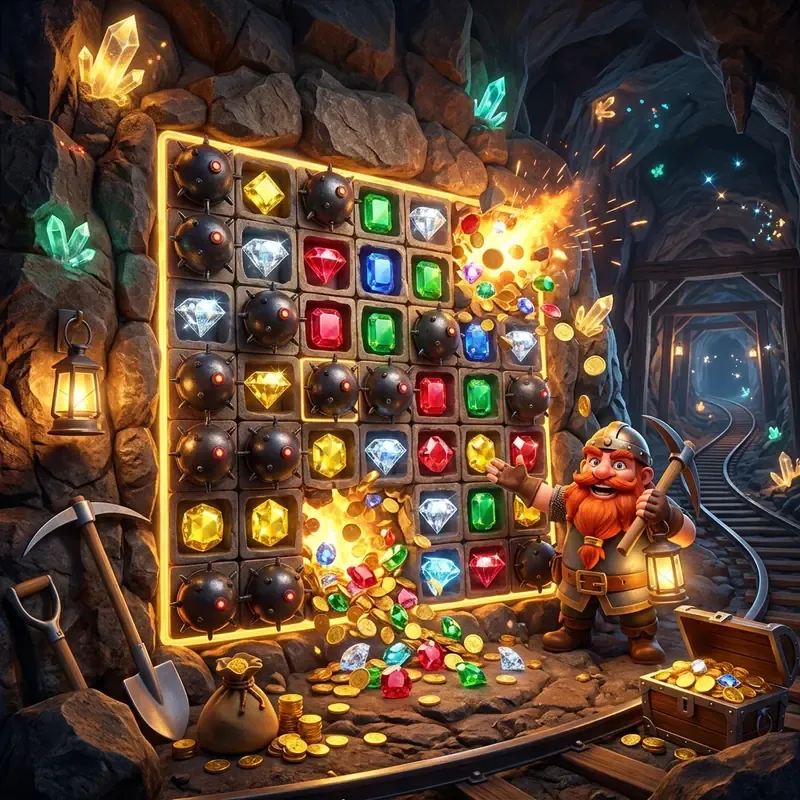
Updated: Mines is distributed as a browser-rendered game client on modern mobile web stacks, which is why most operators publish it as an instant-play title rather than a Mines download. You can reach the game directly through Safari or Chrome on iOS and Android, with the responsive grid intact. Some operators also ship a native or web-wrapped app; where they do, it usually mirrors the desktop lobby rather than adding features.

On mobile, browser versions adapt the 5x5 grid, bet controls and cash-out button to touchscreens without requesting device permissions or storage space. Downloadable native apps exist at some brands, but browser play offers the same encryption standards, the same Provably Fair verification tools and the same game speed, minus the installation risk.

How to install a mobile version safely:

  1. Never side-load third-party APK files from forums, file-sharing sites or unsolicited links. Repackaged casino APKs are a well-documented malware and credential-theft vector.
  2. Open the licensed operator's site in your mobile browser and confirm the domain and the padlock before logging in.
  3. Android: if an official client exists, download the APK only from the operator's own footer or the Google Play listing, then read the permissions requested. A casino client has no legitimate need for contacts, SMS or call logs.
  4. iOS: use Safari's Share → Add to Home Screen to install the progressive web app. You get a full-screen icon with no App Store dependency and no storage overhead.
  5. Keep the app or browser updated, since updates carry security fixes as well as performance work.
  6. Use a strong, unique password and switch on two-factor authentication where the operator supports it.
  7. Verify the casino's licence and reputation before registering, not after depositing.

Data usage and connection quality. The Mines client is light compared with animated video slots: a session consumes only a few megabytes an hour after the initial asset load, which makes it workable on constrained mobile data. Cash out, though, is a live server request. On unstable 3G or congested Wi-Fi, a delayed tap can resolve at a different grid state than the one you saw. On weak connections, prefer low-mine settings with early exits, or set Auto Cash Out so the multiplier is enforced server-side rather than by your thumb.

Mines Mobile and Mines Download Browser

FAQ: Mines Game

Is the Mines game rigged?

In certified builds, no. Outcomes come from a tested RNG or a Provably Fair hash chain fixed before your first click, and laboratories such as GLI, eCOGRA and iTech Labs verify the RNG, RTP and rules. The game is still designed with a permanent house edge, which is not the same thing as being rigged.

Can I guarantee a win in Mines using the Martingale system?

No. Casinos enforce maximum bet caps, every round's outcome is statistically independent, and simulations of Martingale progressions converge on a negative average equal to the built-in house advantage.

What is the RTP of Mines from Spribe?

Vendor documentation lists a theoretical RTP of 97.0%, a stake range of 0.1 to 100 units and Provably Fair verification.

Why do different sites quote 94%, 97% and 99% for Mines?

Because they are describing different products. Hacksaw Gaming's build is published at around 94%, Spribe and Turbo Games at 97%, Stake Originals at roughly 99%. Read the RTP in the help file of the exact game mines build you have open.

How many mines can I set?

On a 5x5 grid, typically 1 to 24. Hacksaw's customisable grids, 3x3 through 9x9, allow up to 80 active mines. More mines mean bigger multipliers per pick and a much higher chance of an instant loss.

Can I withdraw money won in demo mode?

No. Demo credits are virtual, hold no monetary value and cannot be converted or withdrawn under any circumstances.

Do I need to download an app to play Mines?

No. The game runs in a mobile browser. If you want an app-like feel, install the operator's PWA via "Add to Home Screen" on iOS, or download an official client only from the operator's own site or the Google Play listing on Android.

When should I cash out?

There is no universally optimal point, because every extra pick raises both the multiplier and the bust probability. In practice, players on low-risk profiles set a fixed target between 1.20x and 2.00x and take it every round instead of improvising mid-grid.

Does clicking in a pattern improve my odds?

No. Mine positions are fixed randomly before your first pick, so no pattern carries an advantage. Patterns only help you stay disciplined and avoid impulsive clicking.

Is playing Mines legal in Australia?

Online casino services are restricted under the Interactive Gambling Act 2001. Check your own obligations and the operator's licence coverage before depositing, and use BetStop if you want to self-exclude nationally.

Appendix A: Editorial Revisions Log

For transparency, the following claims from the earlier version of this guide have been amended above:

  1. Original claim: "The theoretical Return to Player (RTP) for standard Mines games typically ranges between 95.0% and 97.0%." Amended to a verified range of approximately 94.0% to 99.0%, with a provider-by-provider table, because Hacksaw builds are published near 94% and Stake Originals near 99%.
  2. Original claim: "Minimum bets typically start around $0.10 to $1.00." Reframed as vendor stake ranges (0.1 to 100 units for Spribe and Turbo Games) with a note that operator and currency-specific limits must be confirmed in the cashier and paytable.
  3. Original claim: "Mines is developed primarily on HTML5 technology, rendering downloadable application files unnecessary." Reframed as a distribution observation (browser-rendered instant-play clients) plus a practical safe-installation checklist for Android APK and iOS PWA users.
  4. Original attribution: "Hing et al., 2025; Frahn et al., 2014." Corrected to "Frahn et al., 2014, as reported in Hing et al., AGRC (2025)" to identify the secondary citation accurately.
  5. Original attribution: "Dubach, 2026; Martingale Probability Models." Corrected to "Dubach, 2026" only, as the second label was not an identifiable source.
  6. Original statement: "typically 5x5 containing 25 total cells" Expanded to cover 3x3 through 12x12 configurations and mine counts up to 80 across providers.
Appendix A Editorial Revisions Log. For

Responsible Gambling Notice

This guide is general information about game mechanics and mathematics. It is not financial, legal or clinical advice, and it is not an inducement to gamble. Mines carries a fixed negative expected value, and no system described here can produce reliable profit. You must be 18+ (21+ in some jurisdictions) to gamble. Set deposit, loss and time limits before you play, never gamble with money allocated to essentials, and never chase losses. Free, confidential support is available in Australia through Gambling Help Online on 1800 858 858 and via BetStop, the National Self-Exclusion Register.

Responsible Gambling Notice. This guide is