Quick Tips to Win Blackjack: Basic Strategy for Better Decisions
Written by Claire Bennett, Senior iGaming Content Editor. Last reviewed: 14 February 2026.

Written by Claire Bennett, Senior iGaming Content Editor. Last reviewed: 14 February 2026.
"A useful guide or review starts with what can be verified: basic strategy lowers the house advantage to around 0.5%, but no quick tips to win blackjack can guarantee a winning session or remove mathematical risk." Claire Bennett, Senior iGaming Content Editor (source: editorial brief)
[⚡ THREE THINGS THAT ACTUALLY MOVE THE NEEDLE]

No. No set of quick tips to win blackjack can promise a win, because blackjack is a stochastic card game where every deal carries a built-in mathematical house advantage. Basic strategy optimises each decision for the best long-run expected value. Short-term variance still does whatever it likes, so player results will always swing around that average.
"No agent, even one optimised with reinforcement learning, achieves a win rate above 47.4% under realistic multi-deck conditions." Curriculum Learning for Blackjack RL Agents, arXiv:2403.08811 (2024). https://arxiv.org/abs/2403.08811
That single figure is the honest ceiling of the game. Even a machine playing flawlessly, thousands of hands per hour, with no fatigue and no ego, still loses more hands than it wins. What basic strategy buys you is not victory. It is the smallest possible rate of loss and the longest possible playing time per dollar risked.
[⚖️ RESPONSIBLE GAMBLING DISCLAIMER]
Blackjack is a form of gambling that involves financial risk. Strategic decision-making and basic strategy charts can minimise the mathematical house edge, but they do not remove risk, nor do they guarantee financial returns. Players should set strict deposit and time limits, never gamble with borrowed funds, and treat playing blackjack strictly as entertainment. Services are intended for adults aged 18+ (or the legal age in your jurisdiction) where online gambling is legal. If gambling stops being recreational, seek free and confidential support through local helplines such as Gambling Help Online in Australia (1800 858 858).
Want to put basic strategy into practice? At Casino you can review the current table conditions, including soft 17 rules, 3:2 payouts and surrender availability, which is everything worth checking before your first bet.
Reading the rules before placing your first bet is not optional homework. Rule variations dictate the house edge and quietly modify optimal strategy decisions. Whether the dealer stands or hits on soft 17 (S17 versus H17), how many decks sit in the shoe, whether doubling down after splitting (DAS) is allowed, and whether surrender is offered can shift your expected value (EV) by 0.5% or more.
Under standard multi-deck conditions where the dealer stands on soft 17 and blackjack pays 3:2, basic strategy trims the house edge to roughly 0.4%-0.6% per unit wagered. That range holds up under both analytical combinatorics and large-scale simulation.

"Under standard rules, basic strategy reduces the casino's advantage to 0.4%-0.6% per unit wagered." McKenna, Deriving Perfect Strategy for Blackjack (2023), analytical technical report; cross-checked against simulation results in arXiv:2403.08811 (2024). https://arxiv.org/abs/2403.08811
However, if a blackjack casino alters payouts to 6:5 or restricts doubling down, the mathematical advantage shifts heavily back toward the house. Before you sit down at a physical or online blackjack table, work through the posted conditions:
Table 1: Rule variations ranked by cost to the player
| Red Flag Rule | Approximate Cost to Player | Practical Impact on a $1,000 Turnover |
|---|---|---|
| Blackjack pays 6:5 instead of 3:2 | ≈ +1.39% house edge | Extra ≈ $13.90 expected loss |
| Dealer hits soft 17 (H17) | ≈ +0.20% | Extra ≈ $2.00 expected loss |
| No double after split (NDAS) | ≈ +0.14% | Extra ≈ $1.40 expected loss |
| Doubling restricted to 9, 10, 11 only | ≈ +0.09% | Extra ≈ $0.90 expected loss |
| No surrender offered | ≈ +0.08% | Extra ≈ $0.80 expected loss |
| Dealer wins all ties (rare "push = loss") | ≈ +9.00% | Unplayable, leave immediately |
A 6:5 table with H17 and no DAS can push a "0.5% game" past 2% before you make a single decision. Rule inspection is the highest-value thirty seconds you will spend at any table. In a live-dealer lobby, that information usually sits behind the small "i" icon next to the table name, so it takes one click rather than a conversation.
Basic strategy is the quickest reliable tool for any player because it gives a mathematically proven decision rule for every combination of your two cards and the dealer's upcard. It was derived through exhaustive combinatorial probability and millions of simulated hands, and it removes guesswork by selecting the action, hit, stand, double down, split pairs or surrender, with the highest long-term expected value.
Without it, casual players relying on gut feel face a house edge somewhere between 2% and 4%. Following basic strategy strictly cuts that loss rate to roughly 0.5% under favourable rules. That is close to an eightfold reduction in expected loss, for a memorisation task most players finish over a single weekend.
A 2024 computer science preprint on curriculum learning in multi-deck blackjack showed that even advanced machine learning agents using optimal decision trees could not lift long-term win rates above 47.4% without card counting. Basic strategy really is the ceiling for decision optimisation in fixed-stake play.
"An agent guided by an LLM-designed curriculum lifted its average win rate from 43.97% to 47.41% and cut bust frequency from 32.9% to 28.0%." Curriculum Learning for Blackjack RL Agents, arXiv:2403.08811 (2024). https://arxiv.org/abs/2403.08811
Notice what the machine actually achieved: it stopped busting. Almost the whole improvement came from playing marginal hard totals correctly, not from any exotic betting scheme. That is precisely the skill basic strategy hands you for free.
To execute quick win basic strategy cleanly at the table, follow a strict four-step hierarchy on every hand: Surrender, then Split, then Double Down, then Hit or Stand. Working in that exact order means you never miss a high-leverage move before committing to a plain hit or stand.
"Expected-value analysis places surrender first, because its EV is fixed at −0.5 and can be compared directly against the EV of playing the hand." McKenna, Deriving Perfect Strategy for Blackjack (2023), analytical technical report.
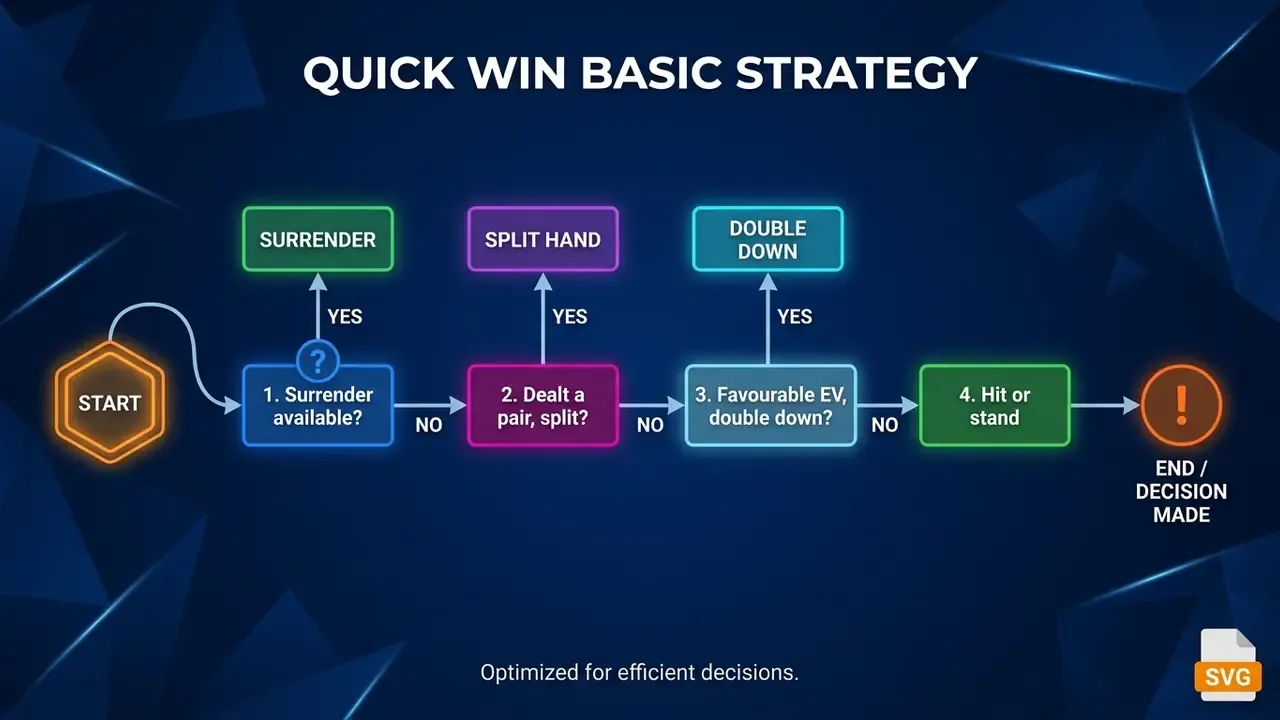
Step-by-step decision order for indexed reading:
Surrender comes first for a mechanical reason: it exists only on your initial two-card hand, before you hit, split or double. Where late surrender is permitted, giving up half your stake locks in an expected value of exactly −0.50 per unit.
Surrender becomes correct whenever the expected loss of playing the hand out is worse than −0.50. Holding a hard 16 against a dealer 9, 10 or Ace, for instance, costs roughly −0.54 to −0.60 units whether you hit or stand. Using quick win surrender in those exact matchups caps the loss at 50 cents in the dollar, which preserves bankroll across a long session.
"With five decks in play and a hard 16, standing carries an expected loss of 0.586 units, whereas surrender fixes the loss at exactly 0.5 units." Evidence-Based Quick Blackjack Strategy Synthesis, 2023-2026 (section 6.3).
Two structural notes matter here. Late surrender is offered only after the dealer checks for blackjack, so it is unavailable when the dealer already holds a natural. Early surrender, which lets you fold before that check, is far rarer and considerably more valuable. If you ever find it, the surrender range widens.
Prioritising quick win split pairs and quick win double down before defaulting to hit or stand lets you press situational advantages where adding money to the felt carries a positive expected return. Once you take a hit, the option to double (at most venues) or split is gone for that hand. Permanently.
Splitting turns awkward starting hands, such as two 8s forming a hard 16, into two workable hands starting with an 8 each. Doubling down lets you add a second unit on powerful totals like 10 or 11 when the dealer shows 2 through 6 and busts often. Only when splitting and doubling are blocked by table rules, or simply unfavourable, should you drop back to the basic choice between hit and stand.
The three tables below cover every possible starting hand in a six-deck game where the dealer stands on soft 17, double after split is allowed and late surrender is offered. Read down the left column for your hand, across the top for the dealer's upcard.
Key: H = Hit · S = Stand · D = Double (Hit if doubling not allowed) · Ds = Double (Stand if not allowed) · SP = Split · SU = Surrender (Hit if not allowed)
Table 2: Hard totals, no Ace or an Ace forced to count as 1
| Your Hard Total | 2 | 3 | 4 | 5 | 6 | 7 | 8 | 9 | 10 | A |
|---|---|---|---|---|---|---|---|---|---|---|
| 5-8 | H | H | H | H | H | H | H | H | H | H |
| 9 | H | D | D | D | D | H | H | H | H | H |
| 10 | D | D | D | D | D | D | D | D | H | H |
| 11 | D | D | D | D | D | D | D | D | D | H |
| 12 | H | H | S | S | S | H | H | H | H | H |
| 13 | S | S | S | S | S | H | H | H | H | H |
| 14 | S | S | S | S | S | H | H | H | H | H |
| 15 | S | S | S | S | S | H | H | H | SU | H |
| 16 | S | S | S | S | S | H | H | SU | SU | SU |
| 17-21 | S | S | S | S | S | S | S | S | S | S |
Table 3: Soft totals, Ace counted as 11
| Your Soft Hand | 2 | 3 | 4 | 5 | 6 | 7 | 8 | 9 | 10 | A |
|---|---|---|---|---|---|---|---|---|---|---|
| A,2 (soft 13) | H | H | H | D | D | H | H | H | H | H |
| A,3 (soft 14) | H | H | H | D | D | H | H | H | H | H |
| A,4 (soft 15) | H | H | D | D | D | H | H | H | H | H |
| A,5 (soft 16) | H | H | D | D | D | H | H | H | H | H |
| A,6 (soft 17) | H | D | D | D | D | H | H | H | H | H |
| A,7 (soft 18) | S | Ds | Ds | Ds | Ds | S | S | H | H | H |
| A,8 (soft 19) | S | S | S | S | S | S | S | S | S | S |
| A,9 (soft 20) | S | S | S | S | S | S | S | S | S | S |
Table 4: Pairs, split decisions across every dealer upcard
| Your Pair | 2 | 3 | 4 | 5 | 6 | 7 | 8 | 9 | 10 | A |
|---|---|---|---|---|---|---|---|---|---|---|
| A,A | SP | SP | SP | SP | SP | SP | SP | SP | SP | SP |
| 10,10 | S | S | S | S | S | S | S | S | S | S |
| 9,9 | SP | SP | SP | SP | SP | S | SP | SP | S | S |
| 8,8 | SP | SP | SP | SP | SP | SP | SP | SP | SP | SP* |
| 7,7 | SP | SP | SP | SP | SP | SP | H | H | H | H |
| 6,6 | SP | SP | SP | SP | SP | H | H | H | H | H |
| 5,5 | D | D | D | D | D | D | D | D | H | H |
| 4,4 | H | H | H | SP | SP | H | H | H | H | H |
| 3,3 | SP | SP | SP | SP | SP | SP | H | H | H | H |
| 2,2 | SP | SP | SP | SP | SP | SP | H | H | H | H |
* In multi-deck H17 games that also offer late surrender, surrendering 8-8 against an Ace is marginally better than splitting. See the advanced exception below.
Choosing between quick win hit or stand comes down to one comparison: your total against the dealer's exposed upcard, weighing your bust risk against the dealer's chance of making 17 to 21.
A hard hand contains no Ace, or contains an Ace that must count as 1 to stay under 22. The dealer's exposed card splits the situation into a "weak card" group (2 through 6) and a "strong card" group (7 through Ace).
When the dealer shows 2, 3, 4, 5 or 6, their bust probability sits between roughly 35% and 42%. Basic strategy therefore tells you to stand on hard totals of 12 through 16 against those weak upcards, with one minor exception: hit hard 12 against a dealer 2 or 3 in specific multi-deck games. When the upcard is 7, 8, 9, 10 or Ace, the dealer's bust rate drops and their chance of reaching 17-21 climbs, so you hit every hard total from 8 up to 16 and try to build something competitive.
A soft hand holds an Ace counted as 11 without going over 21. Ace-6 is soft 17, for example. Soft hands carry zero immediate bust risk on a hit, because the Ace drops back to a value of 1 the moment the total would exceed 21.
That safety net is why basic strategy plays soft hands aggressively. Beginners often stand on soft 17, assuming 17 is respectable enough. It is not. Standing on soft 17 returns a negative expected value against every single dealer upcard. Hitting soft 17, or doubling against a weak dealer card, gives you a free look at soft 18 through 21 with no bust risk attached to that card.
"Reinforcement learning policies confirm that optimal agents play soft hands more aggressively than hard hands, exploiting the Ace's flexibility to maximise expected value." Curriculum Learning for Blackjack RL Agents, arXiv:2403.08811 (2024). https://arxiv.org/abs/2403.08811
[💬 EDITORIAL ADVICE: SOFT HAND EFFICIENCY] "Never treat soft 17 like hard 17. Because an Ace can flex between 1 and 11, taking a hit on soft 17 gives you a free shot at building 19, 20 or 21 with no chance of busting on that card." - Claire Bennett
[💡 QUICK SOFT HAND CHEAT-SHEET] • Soft 13 to 14 (A-2, A-3) ➔ Double vs Dealer 5-6; else Hit. • Soft 15 to 16 (A-4, A-5) ➔ Double vs Dealer 4-6; else Hit. • Soft 17 (A-6) ➔ Double vs Dealer 3-6; NEVER Stand, else Hit. • Soft 18 (A-7) ➔ Double vs 3-6; Stand vs 2, 7, 8; Hit vs 9, 10, A.
Special moves change the shape of the game, either by pressing high-EV situations or by limiting damage on genuinely ugly deals. The matrix below pulls every pair and special action into one reference, with the expected-value nuance attached to each line.
Table 5: Comprehensive basic strategy matrix for pairs and special actions
| Player Pair / Hand | Dealer Upcard | Recommended Action | Exact EV / Rule Nuance |
|---|---|---|---|
| Pair of Aces (A,A) | 2 through Ace | Always split | Profitable against every upcard; ~+36.9¢ vs 8, +27.3¢ vs 9, +18.1¢ vs 10, +12.1¢ vs Ace |
| Pair of 10s / Face | 2 through Ace | Never split | Keep hard 20; standing nets +67.7¢ per $1 vs 5 or 6 (splitting drops it to +42.4¢ / +50.1¢) |
| Pair of 9s | 2-6, 8, 9 | Split | Stand on 18 against 7, 10 or Ace |
| Pair of 8s | 2 through Ace | Always split* | *Surrender vs Ace if H17 and late surrender are both active |
| Pair of 7s | 2 through 7 | Split | Hit against 8 through Ace |
| Pair of 6s | 2 through 6 | Split | Hit against 7 through Ace |
| Pair of 5s | 2 through 9 | Double down | Treat as hard 10, never split. Vs 6: +58.7¢ doubling, +29.4¢ hitting, only +10.4¢ splitting |
| Pair of 4s | 5 and 6 | Split (if DAS) | Otherwise hit; avoids weakening a serviceable total of 8 |
| Pair of 3s / 2s | 2 through 7 | Split | Hit against 8 through Ace |
| Hard 11 | 2 through 10 | Double down | Hit against a dealer Ace (double vs Ace in H17 games) |
| Hard 10 | 2 through 9 | Double down | Hit against 10 or Ace |
| Hard 9 | 3 through 6 | Double down | Hit against 2 and against 7 through Ace |
| Hard 16 | 9, 10 or Ace | Surrender | If unavailable, hit (or stand vs 2-6) |
| Hard 15 | 10 | Surrender | If unavailable, hit |
| Split Aces payout | Any | One card only | A 10 on a split Ace is a non-natural 21, paid 1:1, not 3:2 |
"Simulations show the Hi-Lo system with a correct bet spread produces an edge of roughly 1.35%, unreachable for players who do not count cards." Evidence-Based Quick Blackjack Strategy Synthesis, 2023-2026 (section 2.2).
Keep that number in perspective while you read the tables above. Perfect splitting and doubling do not create an edge, they only shrink one. Moving from −0.5% to +1.35% requires card counting, deep shoe penetration and a bankroll built to absorb brutal swings. Different discipline entirely.
Quick win double down applies when your hand has real potential to form a winning total while the dealer sits on a card that busts often. You add one unit and receive exactly one more card, which is why hand selection matters so much.
Double hard 11 against any dealer upcard from 2 to 10. Double hard 10 against 2 through 9, and hard 9 against the weak cards, 3 through 6. Soft hands from soft 13 through soft 18 also offer solid doubling spots against a dealer 4, 5 or 6, using both the Ace's flexibility and the dealer's raised bust rate.
One clarification that competing guides routinely fumble: the blanket advice "never double on 13 or higher" applies only to hard totals. Soft 13 through soft 18 are standard, profitable doubling hands against a weak dealer card, because an Ace cannot bust on the extra card. Mixing up hard and soft totals here is one of the most expensive beginner errors at the table, and it happens most often on Ace-6, where the display reads "17" and the instinct is to freeze.
Splitting rewards judgement about which cards improve when separated and which are already doing their job together. The foundations are fixed:
Mathematical proof (EV breakdown): standing on 8-8 against a dealer 6 loses an average of 12.5 cents per $1 wagered, and hitting pushes the loss to 43.8 cents. Splitting turns the same deal into an average net return of +38.3 cents per dollar of your original wager. Against a dealer 7, standing loses 48 cents per dollar, while splitting produces a +31.8 cent profit, a 72.6-cent swing in player equity. Even the tightest profitable case, 8-8 against a 2, converts a 28.4-cent average loss into a 7.4-cent profit, a gain of 35.8 cents per dollar of the original bet. Against 8 or higher, splitting shifts from profit-seeking to damage control: 8-8 versus 8 loses 51.3 cents standing and 45.3 cents hitting, but only about 3 cents when split.
Advanced rule exception: "Always split 8s" is the standard rule, yet one rare statistical exception exists. In multi-deck games where the dealer hits soft 17 (H17) and late surrender is permitted, surrendering 8-8 against a dealer Ace carries an expected loss of exactly −50.0 cents per dollar, slightly better than splitting at −51.4 cents. Because surrender always costs precisely half the wager, it works as a hard floor under any hand whose playing EV falls below −0.50.

Quick win surrender is the correct play whenever your expected loss from hitting or standing exceeds 50% of your stake. You give up half the bet, leave the hand and keep the other half.
Late surrender earns its keep mainly on hard 16 against a dealer 9, 10 or Ace, and on hard 15 against a dealer 10. In those matchups, hitting or standing averages a loss of 54 to 60 cents per dollar. Surrender caps it at exactly 50 cents, which is a real mathematical improvement over playing the hand out. In H17 games the surrender range widens a little, taking in 8-8 versus an Ace and, under some rule sets, hard 15 and 17 versus an Ace.
[🔍 FACT CHECK AND MYTH-BUSTING]

Myth 1: "You should always split every pair dealt to you."
Fact: False. Splitting increases your total stake. Splitting 10s or 5s destroys strong totals (20 and 10)
and hands the house extra expected value. Splitting 4s against a strong upcard does the same damage.

Myth 2: "Buying insurance protects your hand against a dealer blackjack."
Fact: False. Insurance is an independent side bet that the dealer's hole card is a ten. Without card
counting, the 2:1 payout is mathematically unfavourable. Basic strategy says never take insurance.
    > "Insurance is profitable only when the true count exceeds +3 under Hi-Lo; without card counting
      it is a negative-expectation bet carrying a 6%-7% house edge."
      Evidence-Based Quick Blackjack Strategy Synthesis, 2023-2026 (section 9.2).

Myth 3: "A losing streak means a win is due on the next hand (Gambler's Fallacy)."
Fact: False. In multi-deck shoe games without card counting, each hand is effectively independent.
Past losses do not change the probabilities of future deals.

Myth 4: "Hitting a hard 12 against a dealer 3 steals the bust card from the table."
Fact: False. Every player's expected value is independent. Cards drawn by one player redistribute
randomly; they do not transfer good or bad luck to anyone else at the table.
Choosing between online RNG software and live dealer tables depends on your immediate priority: learning decision logic without clock pressure, or executing strategy at real-time table speed.
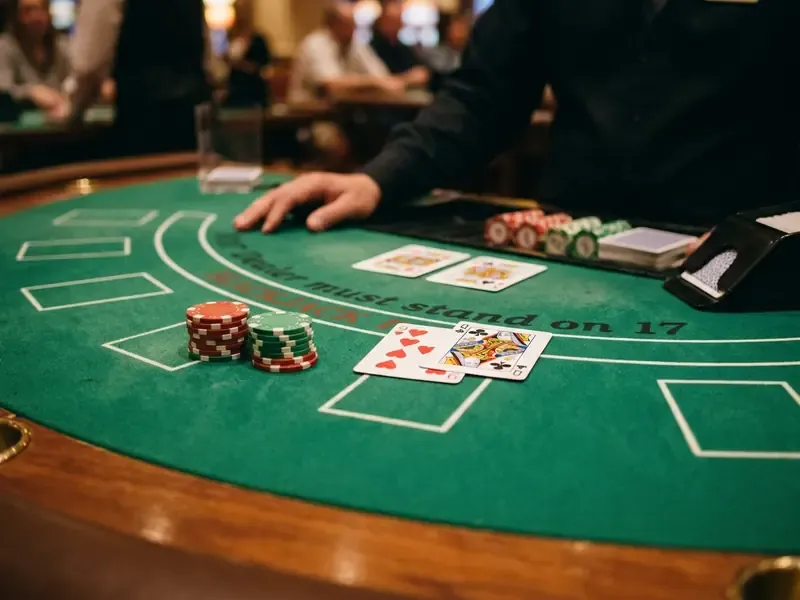
A live blackjack table adds operational pressure that digital RNG games do not: decision timers, physical hand signals and other people watching. At a land-based casino or a live dealer stream, you generally have 15 to 20 seconds to declare your action.
Table dynamics can also tempt you off the chart. Casual players sometimes criticise mathematically correct moves, hitting hard 12 against a dealer 3, or splitting 8s against a 10, claiming you "stole the dealer's bust card".
"Empirical observation of table behaviour records players following basic strategy being criticised by other participants who believe decisions are interdependent." Carlin & Robinson, Empirical Study of Blackjack Table Behaviour (cited in Evidence-Based Quick Blackjack Strategy Synthesis, section 8.1).
Remembering that each player's expected value is independent makes it far easier to stay disciplined and follow the chart, whatever the commentary.

Two more conventions save friction in shoe games: never touch your cards with two hands, and never move your chips once the deal has begun. Pit staff treat both as procedural irregularities, whatever your intent.
Drilling basic strategy on free software or demo trainers before you wager real funds is the cheapest way to remove decision errors. Good trainers flag every deviation from optimal play immediately, which speeds up recall far more than reading a chart does.
Run several hundred simulated hands and you start to build muscle memory for the awkward spots: soft hand doubling, late surrender lines, 9s against an 8. Once your error rate on a free trainer reaches zero, low-stakes real money play becomes a much smaller step.
"Australian online wagering research notes that the ease of topping up an account and the absence of physical exit cues contribute to longer sessions and higher expenditure." National Gambling Trends Study 2023, Australian Institute of Family Studies (AIFS).
That finding matters more than any strategy table. A land-based venue has closing times, travel and a queue at the ATM. An app has none of those brakes. Set a session timer and a loss limit before you open the game, not after the first drawdown.
[⚖️ DISCLAIMER]
This information is general in nature and is not a substitute for professional advice. Online gambling is available only to adults in jurisdictions where it is legal.
Ready to move from practice to real play? Compare the two formats, RNG and live dealer, then choose a table whose rules suit your bankroll at Casino.
[⚖️ DISCLAIMER] This section is general information only and is not legal or financial advice. Gambling legislation differs by state and territory and changes over time. Confirm the current position with your relevant state or territory regulator, or seek independent professional advice, before you play.
[⚖️ DISCLAIMER]
This information is general in nature and is not a substitute for professional advice. Bankroll management reduces financial risk but does not remove it.
Managing your bankroll and reading promotions properly keeps administrative terms from swallowing the thin mathematical edge basic strategy preserves. In practice, bonus fine print destroys more player value than poor hitting decisions ever will. Our editorial team reviewed wagering terms across multiple operators while building our iGaming industry overview, and the most common trap was game weighting, not the headline rollover multiple.

"According to the NSW Gambling Survey 2024, 19.2% of casino table game players fall into the moderate or high-risk category, compared with 5.8% across all gamblers." Browne et al., NSW Gambling Survey 2024, NSW Responsible Gambling Fund / Central Queensland University.
Table games combine concentration, pace and repeat play, and that mix raises exposure. Bankroll rules exist to put a hard ceiling on what a single session can cost you, whatever the cards do.
Small, consistent bets relative to your bankroll protect your funds through the ordinary statistical drawdowns that will happen while you are still learning the chart. Bankroll management literature generally recommends flat betting 1% of your session bankroll per hand as a baseline unit, treating 2% as the upper boundary for low-variance play.
Risk of Ruin (RoR) calculations show that larger fractions raise drawdown exposure sharply rather than gradually. Move from a 1% unit to a 3% unit and the probability of exhausting your bankroll inside a normal multi-hour variance dip climbs a long way.
"The risk-of-ruin approximation ROR ≈ e^(−2 × edge × bankroll / variance) allows the probability of losing an entire bankroll to be calculated for any given bet size." Evidence-Based Quick Blackjack Strategy Synthesis, 2023-2026 (section 7.1).
The formula makes the mechanism plain: ruin probability falls exponentially as bankroll grows relative to bet size, and rises just as fast as variance climbs. Since a flat-betting basic strategy player holds no positive edge, the realistic goal is not avoiding ruin forever but slowing it enough to finish the session you planned.
Worked example, unit sizing in dollars:
| Session Bankroll | 1% Unit (conservative) | 2% Unit (upper bound) | Hands Survivable at 1% in a Worst-Case Run |
|---|---|---|---|
| $100 | $1 per hand | $2 per hand | ~100 hands before total loss |
| $250 | $2.50 per hand | $5 per hand | ~100 hands before total loss |
| $500 | $5 per hand | $10 per hand | ~100 hands before total loss |
| $1,000 | $10 per hand | $20 per hand | ~100 hands before total loss |
With a $100 bankroll and a $25-per-hand habit, four losing hands in a row, a routine event, ends the session. At $1 per hand the same four losses cost 4% of your funds and your practice continues. There is a second implication in that table: if the table minimum is $10, a $100 bankroll is structurally too small for that table, and no amount of correct play repairs the mismatch.

Before activating any bonus, read the wagering terms and blackjack contribution rate at Casino. Our editorial team has checked the key parameters, so the restrictions should not catch you out at cash-out.
Guide last reviewed 14 February 2026. Rules, bonus terms and payment conditions change, so check the current table and promotion details before you play.